

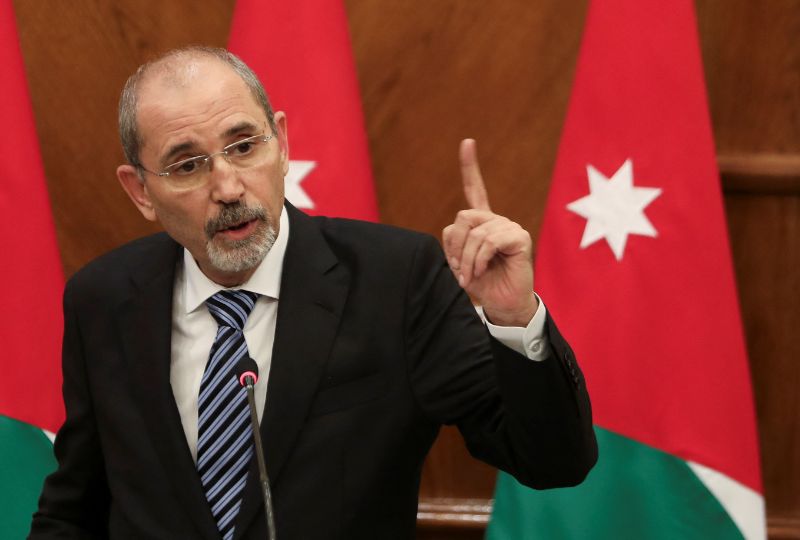
Jordan’s foreign minister said yesterday the country feared the worst was yet to come in the Israel-Hamas war, with no signs of success in efforts to de-escalate tensions.
A deadly rampage on October 7 by Hamas killed 1,400 people, prompting Israel to bombard the Gaza Strip in strikes that have killed thousands and made more than a million homeless.
In remarks at a Press conference with his German counterpart, Ayman Safadi said the war would have “catastrophic repercussions” and urged “protecting the region from the danger of its expansion”.
“All the indications are that the worst is coming.. The catastrophe will have painful consequences in coming periods,” Safadi said, adding that diplomatic efforts were not yielding any results in ending the conflict.
“The decision to end the war is not with us, it’s with Israel and we must exert all efforts to end it,” Safadi said.
Fears of a widening war also cast a shadow on a meeting between Jordan’s King Abdullah and Egyptian President Abdel Fattah Al Sisi yesterday in Cairo.
In a statement after the meeting, the two leaders said they rejected forcibly displacing Palestinians and that Israel was “imposing collective punishment” on the inhabitants of Gaza by bombing civilians after the Hamas attack.
In Amman, Safadi said that the kingdom would confront “with all its means” a mass displacement of Palestinians that results in major changes to the region.
“We won’t accept such a solution. This is a red line and would be a declaration of war,” he added.
The conflict has stirred long-standing fears in Jordan, home to a large population of Palestinian refugees and their descendants, that a wider conflagration would give Israel the chance to implement a transfer policy to expel Palestinians en masse from the West Bank.
Jordan, which shares a border with the West Bank, absorbed the bulk of Palestinians who fled or were driven out of their homes when Israel was created. “We won’t allow Israel to export the crisis it created to Jordan,” Safadi said.
Meanwhile, Israeli forces raided and carried out an air strike in a Palestinian refugee camp in the occupied West Bank yesterday, killing at least 12 people, Palestinian officials said, and Israel’s police said an officer was killed during the raid.
The Israeli military said the strike, a rare use of air power in the West Bank, targeted a group of Palestinians “that posed a threat to the soldiers in the area”. It said it had arrested 10 Palestinians during the raid.
The Palestinian Authority’s official news agency WAFA said dozens of Palestinians were wounded during the clashes in the Nur Shams refugee camp, adjacent the central city of Tulkarm near the territory’s border with Israel.
Since October 7, Israeli troops have killed more than 70 Palestinians and arrested more than 800 in the West Bank, according to Palestinian officials.
The military said it carried out yesterday’s raid in Nur Shams “to apprehend wanted suspects, destroy terror infrastructure, and confiscate weapons.”
Israel’s police said a reserve service member who was part of an undercover unit was killed during the raid. It did not provide details.
WAFA reported that seven of the dead had been transported to hospital, while the five others were in a mosque inside the camp.
In Ramallah, rare chants this week supporting the military wing of Hamas showed a growing appetite for armed resistance.
“Give people weapons. Let them clash. We’ll show what we can do,” said Salah, a 20-year-old demonstrator who gave only his first name.
Fatah official Mowafaq Sehweel told Reuters: “We should let go of the reins and use whatever means to fight occupation.”
Palestinian officials and Israeli analysts say a number of factors are both helping to ignite tensions, but conversely also limiting their scope, for now.
One is the hundreds of arrests Israel has made.
Hamas cited attacks on West Bank Palestinians and arrests this year as part of its reason for attacking on October 7.
But the arrests have also limited West Bank violence, said Mustafa Al Khawaja, a 52-year-old anti-settlement activist.
“In Gaza, there’s enough time (for Hamas) to organise militarily,” he said. “Here, the occupation (Israel) can clamp down on a daily basis. It leaves no space to build up military or political forces.”
Meanwhile, a Lebanese civilian was killed yesterday near the border with Israel, Lebanese security sources and the UN peacekeeping force UNIFIL said, in an area of the border where Israeli forces and Lebanese group Hezbollah had a heavy exchange of fire.
Earlier in the day, Iran-backed Hezbollah said it had fired rockets at an Israeli position in the village of Manara and Israel had responded with shelling, the latest exchange in the worst bout of violence on the border in 17 years.
“The Lebanese Armed Forces requested UNIFIL’s assistance for seven individuals stranded near the Blue Line, close to Sheikh Abad’s tomb, during a significant exchange of fire across the Blue Line,” UNIFIL spokesperson Andrea Tenenti said.
He said UNIFIL contacted the Israeli army to request it cease fire in order to rescue the group. “Tragically, one person lost his life during this incident and the others were successfully rescued,” Tenenti said.
A Lebanese security source said the Lebanese civilian was killed by Israeli fire and another person was wounded. The incident was around Hula, which lies in an area across the border from Manara, the source said.
The Israeli military said that fighters in Lebanon had fired at least two anti-armour missiles into Israel, striking the border village of Manara without causing casualties.
&uuid=(email))