

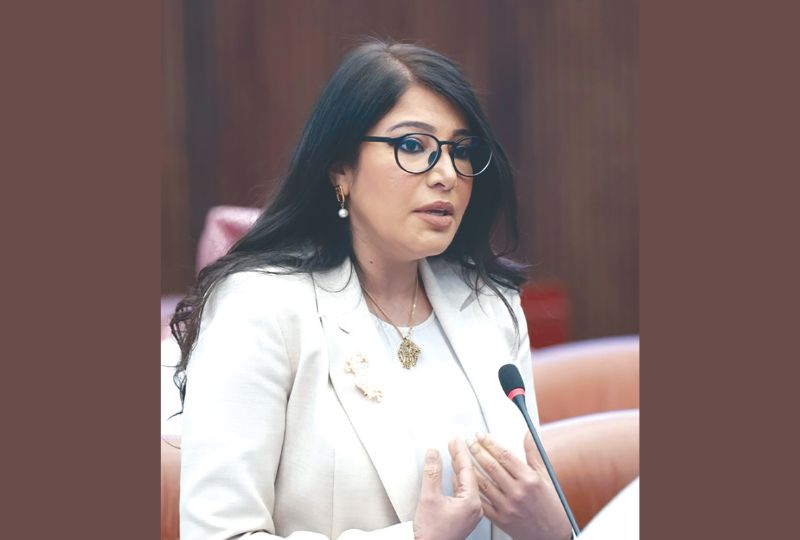
A proposal to allow Bahraini housewives to voluntarily join the national social insurance system is set for debate during Parliament session on Tuesday.
The amended draft law, spearheaded by Strategic Thinking Bloc member Dr Mariam Al Dhaen, would add a new chapter to the Social Insurance Law Decree-Law No 24 of 1976, enabling housewives to subscribe to social insurance on an optional basis by paying contributions according to a chosen income bracket.
Contributions would be set with a minimum equivalent to the pension threshold and a maximum cap of BD500.
Dr Al Dhaen said the bill recognises the economic and social value of unpaid domestic work while offering long-term financial security.
“Housewives play a fundamental role in building stable families and, by extension, a stable society. This proposal translates that value into tangible social protection,” she said. “It gives women who dedicate their lives to their homes the option to secure a pension and insurance coverage in their own right, rather than relying solely on indirect eligibility.”
The services committee’s report outlines that the proposal was studied to produce a legally and financially balanced amended version.
The legislative and legal affairs committee confirmed the draft is constitutionally sound, while the financial and economic affairs committee highlighted its potential to provide a financial safety net in cases of retirement or disability and inject new liquidity into the pension fund managed by the Social Insurance Organisation (SIO). However, it stressed the need for an actuarial study to assess long-term obligations and revenues.
Dr Al Dhaen acknowledged these concerns.
“We fully agree that an actuarial assessment is essential before implementation. The aim is sustainability. Expanding the contributor base could, in fact, help address actuarial deficits if structured correctly,” she said.
Views from stakeholders were mixed.
The Supreme Council for Women noted that many forms of social protection for non-working women already exist through pensions, social assistance, unemployment insurance and royal humanitarian support. It cautioned that implementation challenges include the ability of housewives to maintain contributions and the implications of combining social assistance with insurance benefits.
Meanwhile, the Bahrain Women Union argued that while the proposal diverges from the traditional structure of social insurance, it highlights the need to formally recognise unpaid domestic labour as part of the national economy and to enshrine that recognition in legislation.
Dr Al Dhaen said the proposal draws from international experiences in optional retirement schemes for non-working women.
“This is not about replacing existing social assistance. It is about offering choice and dignity – the ability for a woman to plan her financial future independently,” she added.
The services committee said the bill is grounded in seven principles, including social justice, women’s empowerment, expanding insurance coverage to currently excluded groups, supporting sustainable development goals particularly poverty reduction, and learning from global best practices.
If approved, the law would introduce a new Article (44 bis) under a new chapter in the existing legislation, with an executive provision regulating its implementation.
Services committee chairman MP Mamdooh Al Saleh endorsed the proposal, describing it as a step towards ‘inclusive and fair social protection’.
mohammed@gdnmedia.bh
&uuid=(email))