

PHYSICAL energy infrastructure and linkages have thus far kept the Gaza conflict from escalating and could prove to be a catalyst for peace, rather than conflict, delegates at a top regional defence and security conference heard yesterday.
This was amongst the highlights of the fifth plenary session of the 19th International Institute for Strategic Studies (IISS) Regional Security Summit: The Manama Dialogue 2023, which ended yesterday at the Ritz-Carlton Bahrain.
The session was titled ‘The New Politics of Energy Security’ and was moderated by IISS director-general and chief executive Dr Bastian Giegerich.
US deputy assistant and senior adviser to the president for energy and investment Amos Hochstein highlighted that energy infrastructure and physical connectivity between countries not only support peacetime efforts by creating efficiencies, but also create an additional cost of conflict that countries have to worry about.
“It means that the cost of conflict is not just the human cost, which countries somehow are willing to bear, but also there’s going to be a price cost so when you have a pipeline, and you cut it off, then that will cost you the replacement costs, which will always be high,” he added.
“In many conflicts that we’ve seen, there’s a hesitancy to stop those connections. So I believe not just in the physical infrastructure in this region, but also connecting the Gulf to the wider global market is going to have that effect.”
The East Mediterranean Gas Forum secretary-general Osama Mobarez asserted that his organisation was trying to make energy and gas a “catalyst for peace, and avert the classical view about energy as a fuel for conflict”.
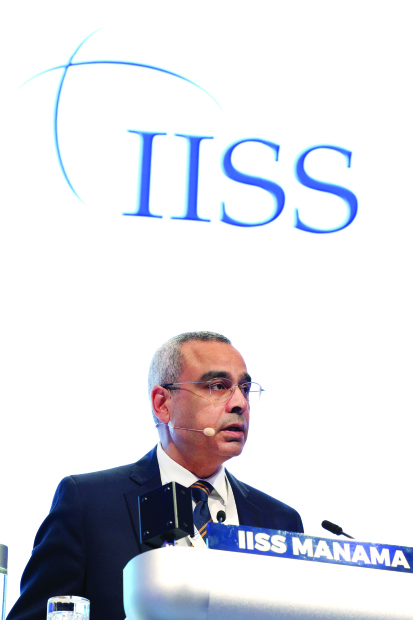
Mr Mobarez
He cited the example of the Arab Gas Pipeline, built to export Egyptian natural gas to Jordan, Syria and Lebanon, with branch underwater and overland pipelines to and from Israel.
He also cited Qatar’s Dolphin Gas Project, which continued to provide natural gas to Oman and the UAE in 2017 despite geopolitical challenges at the time.
During the session, Greek national security adviser Dr Thanos Dokos also noted that the Turkiye–Greece gas pipeline continued to operate despite numerous “bilateral problems” between the two countries.
Mr Hochstein also cited the example of the Israel-Lebanon maritime deal, which he was instrumental in brokering in his role, noting that so far it has not been breached, and allows both countries to exploit natural resources of the area.
“For the very first time, it created a border recognised by the UN that two countries that do not have diplomatic relations – one (Lebanon) doesn’t event recognise the mere existence of the other,” he added.
Although oil or gas have yet to be discovered in the area, Mr Hochstein remained hopeful.
He was also optimistic about Palestinians being able to monetise and secure energy independence by exploiting the offshore Gaza Marine gas field.
The panellists, which also included GCC secretary-general Jasem Albudaiwi, also discussed energy transition in the region.
Mr Albudaiwi acknowledged and highlighted each of the GCC country’s commitment to transitioning to renewable energy, including Bahrain’s commitment to acquire 20 per cent of its energy needs through renewable sources by 2035 and the UAE’s commitment to get 44pc of its needs from clean energy sources by 2050.
He also highlighted that the GCC has acknowledged the importance of traditional energy supplies in the long term, as global energy demands are forecast to rise by 23pc by 2045, anticipating that oil and gas were “still expected to meet over 50pc of global energy needs by then”.
Mr Hochstein noted that as countries in the region and around the world moved towards renewable energy sources, the potential for multi-national energy projects grew, which could provide stable relations as sub-sea cables replaced oil pipelines.
naman@gdnmedia.bh
&uuid=(email))