

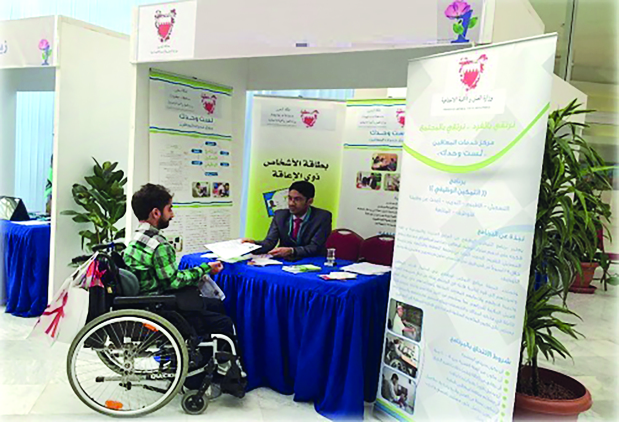
Employers are being urged to promote a diverse and inclusive work environment by offering more jobs for citizens with disabilities.
The Shura Council will debate amendments to the 2006 People with Disabilities Care, Rehabilitation and Employment Law that could see ministries and government bodies doubling their quota for the disabled from two per cent to 4pc, alongside businesses and companies.
Five Shura members, led by Sabeeka Al Fadhala, have submitted a proposal to double the number of Bahrainis with special needs at workplaces with more than 50 employees.
However, Shura’s services committee amended it to include ‘all workplaces’ in line with constitutional and international labour rights. It also added a clause that stipulates that the individual’s disabilities should match the available vacancies and allotted duties.
The panel said the Labour Minister, in consultation with the Social Development Minister and the Civil Service Commission president, must regularly determine jobs that differently-abled people can take up in government or private sectors following the Cabinet’s approval.
The proposal will be discussed during the weekly Shura session on Sunday.
Labour Minister Jameel Humaidan told the committee that there were 321 jobseekers with special needs, out of which 105 have mental disabilities.
Social Development Minister Osama Al Asfoor said there were 13,765 individuals registered with the ministry.
“A total of 3,990 individuals suffer from physical disabilities, 2,210 from hearing problems, 1,302 have visual impairments, 5,332 have mental and psychological disabilities, and 911 are coping with multiple disabilities,” he added. “They receive between BD100 and BD200 a month, costing the government around BD1.64 million.”
Meanwhile, Ms Al Fadhala said the minimum two per cent quota was introduced 17 years ago to find government jobs for people with disabilities.
“Those days, employers believed that they cannot handle jobs like able-bodied people,” she said.
“Times have changed and workplaces today hire Bahrainis with disabilities not because they are obliged to, but due to the fact that the country has come a long way in ensuring the rights of such individuals,” she added.
“Citizens with disabilities have proven that they are as capable as able-bodied people. The proposed 4pc quota is a legislative step-up to ensure more jobs for people with disabilities.”
She said legislative intervention alongside enhancements by the committee to improve the law will continue as more ideas were on the way.
“People with special needs deserve, and are entitled to, more benefits. There are limitations within rules which we will be working to overcome legislatively,” she said. “This doesn’t mean we are behind; on the contrary, we are leaders in the field of protecting the rights of such people, and the bar has to be raised further to achieve more.”
The 4pc rule was implemented in Kuwait at the start of the year.
Also scheduled for debate during the session is an amendment to Article 16 of the 2007 Vocational Training Law, which could force companies with 50 or more employees to provide training for Bahraini university graduates.
Under the changes proposed by five members led by Ejlal Bubshait, for every 50 employees, businesses will be obliged to provide training for one university graduate for at least three months.
The Labour Ministry would provide a list of trainees to companies, detailing their responsibilities and work conditions besides payments due from the provider and wage support from the government.
Meanwhile, Information Minister Dr Ramzan Al Nuaimi, who is politically responsible for the Bahrain Authority for Culture and Antiquities, said there were several initiatives to support those seeking to pursue a career in music, calligraphy, painting, literature and poetry, cinema, and traditional arts and handicrafts.
“We have cash rewards for achievers in each category, with the biggest being the Bahrain Pearl Award presented in March every two years,” said Dr Al Nuaimi, in a written response to a question by Shura member Nancy Khedouri.
Meanwhile, Education Minister Dr Mohammed Juma said, in response to a question by Shura member Dr Hani Al Saati on plans to develop education in the country, that advanced teaching and learning methods were being constantly introduced.
“We have integrated artificial intelligence and modern edutainment approaches in schools and introduced active education that matches labour market needs from a young age,” Dr Juma said. “It is not just books or educational materials that are being developed but also the capabilities of teachers, instructors and administrators.”
Shura members will be notified about the two responses during the weekly session.
mohammed@gdnmedia.bh
&uuid=(email))