

An award-winning short documentary chronicling a father and son’s passion for Bahraini traditional donkey racing is set to be extended into a feature film later this year.
Directed by Bahraini filmmaker Mohammed Jassim, Bar Saar was among seven films to win a prestigious accolade at the Sharjah Film Platform Awards last December, selected from 38 entries featured at the festival.
Mr Jassim, who suffers from sickle cell disease, says he edited the movie during a long stay in hospital following the tragic loss of his six-year-old son.
“I would go to the Bar Saar donkey racetrack every Friday, where I met the two main figures of the film – Ali and Ahmed Al Dhawady,” the 33-year-old videographer from Dair told the GDN. “I spent three years with them, filming them and documenting their lives,” he said.
Over the course of the 33-minute film, the viewer gets to witness the real-life story of a father and son team with a close but turbulent relationship unravelling along the patches of desert in Saar.
Father Ali, also known as Abu Ahmed, is a simple man in his 50s with an exceptional and sometimes excessive love for animals and, in particular, donkey racing.
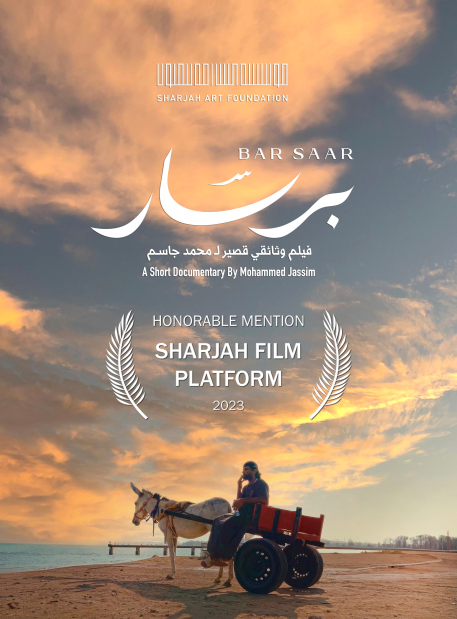
The award-winning movie’s poster
Through the immersive story unfolding on the screen, viewers get to experience the intense sporting action on the course with Ali and Ahmed and get a taste of the ups and downs of the Bahraini heritage activity.
At the end of the film, Abu Ahmed’s over-the-top enthusiasm for the races drives Ahmed to quit the sport. The equine saga concludes with an idyllic, open-ended scene of the Dhawadys’ precious donkey bathing in the sea near Hidd.
“Making the documentary wasn’t easy at all. After I finalised filming, a tragedy befell me and I abandoned the film – I lost my son, Jassim,” he explained.
“My son’s death was a huge shock for me, I fell into a health crisis and I was bedridden for two months.”
Despite being overcome with grief, he eventually managed to finish the film project thanks to the support of his friends and co-producers of the film, editor Ahmed Akbar and cameraman Mohammed Alnahham.
Mr Alnahham and cinematographer Jaffar Alhalwachi helped Mr Jassim with camera work, and the film’s gorgeous hues were edited by colourist Ahmed Abdulnabi.
“We completed the final editing and made the submission while I was in the hospital,” he said.
In 2022, Mr Jassim had managed to secure the Sharjah Film Platform Short Film Production Grant, aimed at funding movies that ‘test the boundaries of contemporary filmmaking’.
It was selected as one of five projects to secure the funding receiving a portion of the $30,000 (BD11,307) endowment split among the five filmmakers.
Bar Saar went on to win Honourable Mention in the Documentary Short category of the 2023 edition of the Sharjah Film Platform.
“I wanted the film to be longer, since I shot so many dramatic and exciting events, but they need screentime to unfold,” he said. “I didn’t have an opportunity to include them because of the time limit.”
Now, Mr Jassim wants to make a feature-length version and is looking for further funding in order to be able to produce it and make his dream a reality.
“Although it was tough, the filming stage was my favourite since I was enjoying the atmosphere and spending time with people who have a great sense of humour,” he added.
The Dair native told the GDN he began his film-making journey while roaming Bahrain’s villages, exploring their alleyways and farms, and interviewing elderly villagers.
Although he started with nothing but his phone camera, the talented Bahraini spent years honing his craft and is now the official videographer of Manama Club.
A previous film of his, which documented the effects of land reclamation in his beloved Dair, was displayed in six film festivals in the UK, South Africa, Japan, Serbia, Iraq and Spain.
Titled Raah (Arabic for ‘Gone’), the 2020 documentary portrayed the plight of the villagers who lost their livelihoods as fishermen, winning two awards.
Mr Jassim does not know when Bar Saar will be available to watch in Bahrain, despite many people asking him how they can view it.
“Right now, I can’t publish it online because festivals and contests do not accept published works,” he explained. “I wish I could screen the film in Bahrain among my people, family and friends, but there appears to be no place here to screen independent films.”
zainab@gdnmedia.bh
&uuid=(email))