

.jpg?20260923')
A new manual that highlights the rights of employers of domestic workers to ensure a balanced workplace environment for all parties will soon be launched by a government agency.
The Labour Market Regulatory Authority (LMRA) took the first step yesterday by holding a consultative workshop at the InterContinental Regency.
The watchdog will launch the project in conjunction with the International Organisation for Migration (IOM).
The manual aims to educate employers of domestic workers (housemaids, gardener, cook, guard, driver, etc.) about their rights and commitments which they are not often aware of.
“There is a pre-arrival orientation programme in partnership with the LMRA that has already been launched,” LMRA’s Partnership and Outreach director Fahad Al Binali told the GDN yesterday.
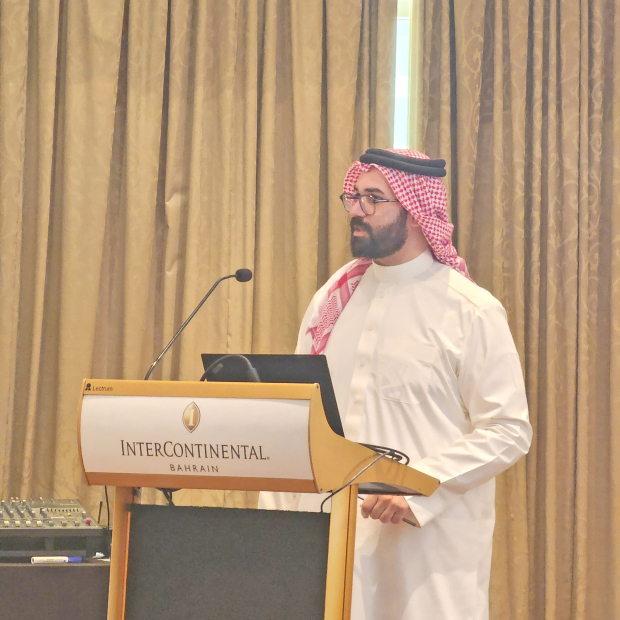
Mr Al Binali
“This means the domestic worker comes into the workplace knowing more about his or her rights than the employer.
“There is an awareness imbalance and its important to ensure both parties are aware of their rights and responsibilities because this eliminates unintentional injustice or friction in the relationship.
“Employers may not be aware that domestic workers are eligible for end-of-service indemnity. They should have access to mobile phone and their passports cannot be retained, which employers may do unintentionally.”
Mr Al Binali said the handbook will be distributed electronically, and physically handed out to employers during visa renewals, recruitment agencies and promoted on social media.
“We will be launching a handbook highlighting the rights for employers after consultations and recommendations today,” he said.
LMRA officials also highlighted the Optional Insurance System for Domestic Workers launched in 2021 that covers compensation in cases of injury, disability, or death.
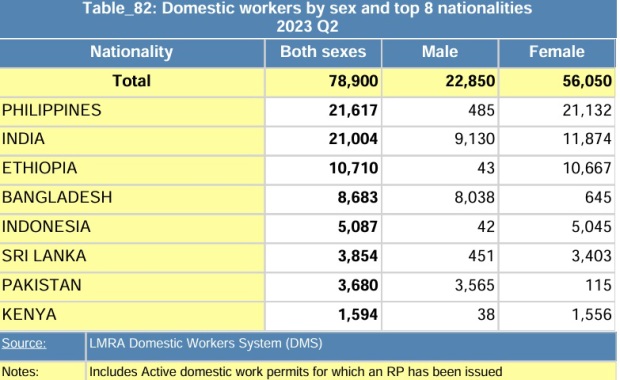
A breakdown of the domestic workers’ nationalities according to LMRA data for the second quarter of last year
Different packages are available for employers to choose from, and prices range from BD40 and BD120 for a one-year period, and between BD60 and BD180 for a two-year period.
LMRA’s Protection and National Referral Mechanism chief Saud Yateem, in his presentation yesterday, highlighted the exploitative situations including trafficking that workers face globally.
He outlined the grievance mechanisms in place locally, including the national human trafficking hotline – 995 and Expat Protection Centre in Sehla that provides services and legal help.
“The hotline offers assistance in 13 languages and we receive 180 to 200 walk-ins from embassies, law enforcement and government agencies every day,” Mr Yateem highlighted in his presentation. “The cases range from passport retention by employers to even the most serious of situations where there is either sexual exploitation or potential human trafficking.”
During the question and answer session, Mr Yateem said LMRA probes all allegations and deploys administrative tools when needed to deal with complex cases.
He said they work closely with the Interior Ministry and the Public Prosecution to deal with sensitive matters.
Yesterday’s meeting was attended by diplomats, community leaders and members of civil societies.
IOM’s Ad Interim Chief of Mission in Bahrain Erika Broers praised the “pioneering initiative” by the LMRA which she said is in line with the National Human Rights Action Plan (2022-2026).
“I think it’s vital to support this programme to ensure both the employer and domestic worker have timely access to relevant information to support both sides,” said Ms Broers.
She highlighted that Bahrain is signatory to the Global Compact for Safe, Orderly and Regular Migration (GCM), and steps taken are in the right direction which reflects the country’s commitments.
Also present at the meeting was Pravasi Legal Cell Bahrain Chapter head Sudheer Thirunilath who spoke about the issue of employers withholding passports of domestic workers. He represented the Migrant Workers Protection Society during the meeting yesterday.
“We have come across cases where if a domestic worker wants to switch jobs and his or her passport is with the employer, the latter files a runaway case against them, leaving them in a mess without any job,” claimed Mr Thirunilath.
According to LMRA’s latest data for the second quarter of last year, 78,900 domestic workers, including 22,850 males, were working in the country.
sandy@gdnmedia.bh
&uuid=(email))