

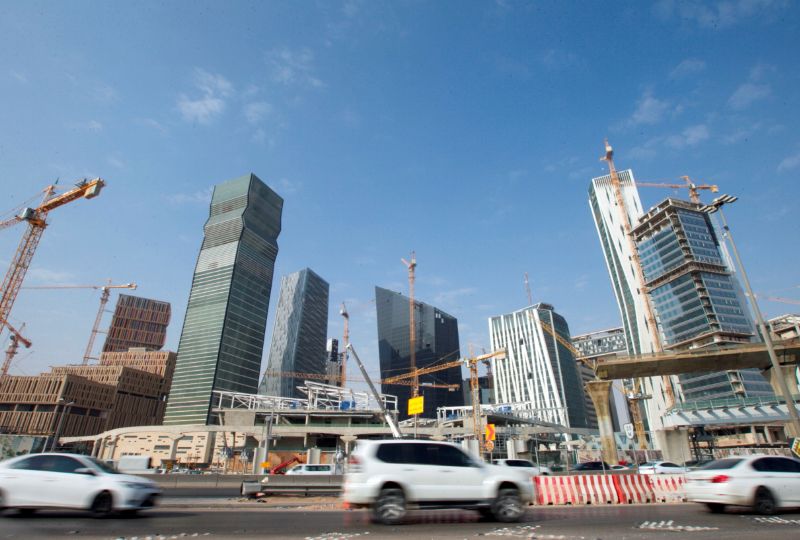
Saudi banks and the capital market are poised to make substantial contributions alongside the Public Investment Fund in achieving the objectives of Vision 2030, stated a report by S&P Global.
The latest analysis by the global rating agency underscores that their involvement in the kingdom’s economic diversification endeavours will enhance leverage in both the Saudi private sector and the broader economy, said a report by Arab News.
The report, citing public sources, indicated that the Saudi government’s transformation programme aimed at enhancing the country’s economic, social and cultural diversification will necessitate approximately $1 trillion in investments over several years.
“Part of this sum will come directly from the government and the Public Investment Fund, but S&P Global Ratings also expect banks and capital markets to contribute a significant amount,” said the US-based agency in the report.
It added: “This will inevitably increase leverage in the Saudi private sector and the broader economy, albeit from low levels. The pace and extent of the increase in leverage in the corporate sector remain uncertain.”
As per the report, Saudi Arabia’s banking sector maintains a robust position, characterised by strong asset-quality indicators and overall capitalisation.
The credit rating agency further anticipates that the banks’ sound profitability and conservative dividend payouts will persist, thereby bolstering their capitalisation over the next one-to-two years.
S&P Global highlighted the expansion of the capital market in the kingdom, noting that from January to May 2024, 13 private companies have announced potential listings on Saudi Arabia’s main market and parallel market.
The analysis projected that Saudi Arabia will experience a real gross domestic product growth of 2.2 per cent in 2024 and 5pc in 2025, with the non-oil private sector emerging as a key contributor to this expansion.
Earlier this month, S&P Global, in another report, noted that banks in Saudi Arabia are expected to pursue alternative funding options to manage the rapid expansion in lending.
The agency said that this pursuit of external funding could potentially impact the credit quality of Saudi Arabia’s banking sector.
“The ongoing financing needs of the Vision 2030 economic initiative and relatively sluggish deposits growth, is likely to incentivise banks to seek alternative sources of funding, including external funding,” said S&P Global.
Meanwhile, Saudi banks extended loans worth 2.67 trillion riyals ($711.5bn) in March, marking an 11pc increase as compared to the same month in 2023, according to the latest official data.
Figures released by the Saudi Central Bank showed personal borrowings accounted for 35pc of this growth, while the remaining 65pc went to the corporate sector, particularly for real estate activities, as well as electricity, gas and water supplies.
Real estate financing for corporate dealings specifically surged by 27pc in the third month of the 2024, marking the highest annual growth rate in 10 months, reaching 275.2 billion riyals.
A study by Mortor Intelligence, which used 2023 as a base year, estimated the kingdom’s real estate market at $69.51bn in 2024, and expects it to reach $101.62bn by 2029, growing at a compounded annual growth rate of 8pc between 2024 and 2029.
The surge in real estate and construction endeavours may have heightened the need for debt-based financing primarily sourced from the local banking sector. Saudi banks play a central role in the provision of loans for real estate projects.
According to the Saudi Central Bank data, new retail residential mortgage loans experienced a notable increase, reaching a 14-month high at 7.63bn riyals in March. This marked a 5pc rise compared to the amount granted in the same month last year and a 10pc increase from the previous month.
In March, lending for home purchases accounted for the largest portion, comprising 64pc of new mortgages to individuals, totalling 4.91bn riyals. The most notable growth, however, was observed in apartment loans, surging by 28pc to reach 2.24bn riyals. Meanwhile, land loans experienced a more modest growth of 4pc, reaching 474m riyals in new mortgages.
&uuid=(email))