


Historical temples in Barbar could be registered collectively as a World Heritage Site as part of efforts to preserve areas of historical value in the kingdom.
The remains of three ancient temples from the Dilmun era are located close to the village near Saar. Historical documents prove that the first one dates back 3,000 years, the second constructed 500 years later and the third built between 2,000 and 2,100BC.
The remains, known as ‘Barbar Temple’, have been targeted by thieves as recently as 2008, when a large, heavy bowl-like artefact disappeared. Investigators suggest a ‘commissioned gang’ stole the valuable artefact for a third party.
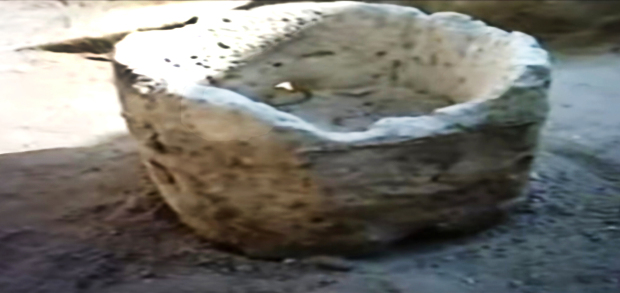
The only remaining picture of the stolen bowl
Although international criminal police organisation Interpol was alerted it remains missing. The object was likely to have carried water for rituals to worship the Sumerian god of water, Enki, conducted at the temple situated by a natural spring.
Northern Municipal Council chairman and area councillor Dr Sayed Shubbar Al Wedaie said during yesterday’s council meeting that he feared other relics could be at risk if it was not properly secured.
“The site in Barbar hasn’t received enough attention, we need to protect the temples from climate change and preserve their features from further deterioration and damage,” said Dr Al Wedaie.
“We have submitted a proposal to study a development project, in partnership with the private sector, to protect the site. This includes construction of a building that covers the main site of the temple to shield it from extreme weather conditions.
“Appropriate facilities and utilities must also be developed at the site to ensure those interested – such as intellectuals, artists and tourist delegations – can visit them comfortably.”
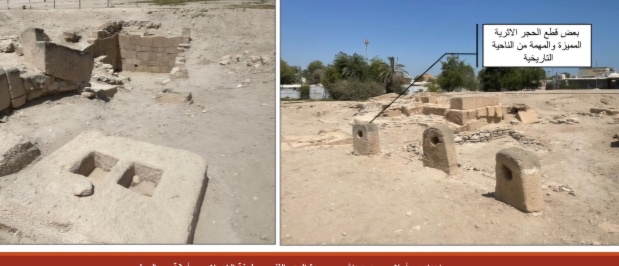
The historic site
Councillors proposed allocating space for private parking of vehicles in addition to a rest stop for visitors, as well as a special location for cultural meetings and activities. They also suggested the construction of a ‘miniature heritage village’ where locally produced palm frond products could be displayed, in addition to staging other cultural activities.
Dr Al Wedaie highlighted concerns raised by cultural and heritage experts about the impact of climate change on historical sites.
“The main features of the site could erode due to exposure to sun and rain, while the walls and structures may further degrade over time,” he said. “Failure to provide the required protection could lead to tampering and theft of the heritage features.”
Councillors claimed that the 29,950sqm site lacked adequate protection, security, CCTV cameras and lighting.
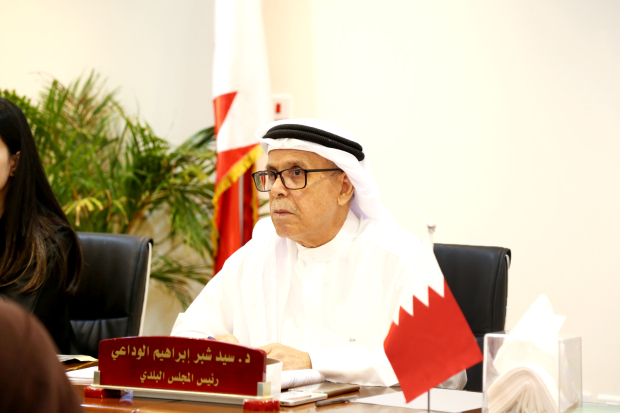
Dr Al Wedaie during yesterday’s meeting
“There is a lack of proper infrastructure and roads leading up to the site, while the entrance is unremarkable,” he added.
“We have proposed collaborating with the private sector to develop a comprehensive strategy to preserve the site and develop it further as we work to get World Heritage Site status from Unesco.
“It is of dire importance to strengthen the security around the site to prevent encroachments and any theft of its components.
“Barbar Temple has the potential to be a wondrous destination for tourists. Why else would thieves be so interested in what is inside?”
Councillors unanimously approved the proposal which has been referred to Municipalities Affairs and Agriculture Minister Wael Al Mubarak to forward to Information Minister Dr Ramzan Al Nuaimi, who is politically responsible for the Bahrain Authority for Culture and Antiquities (Baca) for review.
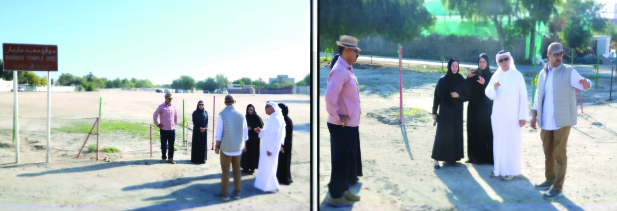
Dr Al Wedaie during a visit to the site with Baca officials
Archaeologists from Baca had earlier indicated that heritage sites in Saar, A’ali, Barbar, Halat Bu Maher, Qal’ah, Al Sayah and Hawar Islands had already suffered varying levels of deterioration and need urgent protection.
mohammed@gdnmedia.bh
&uuid=(email))