

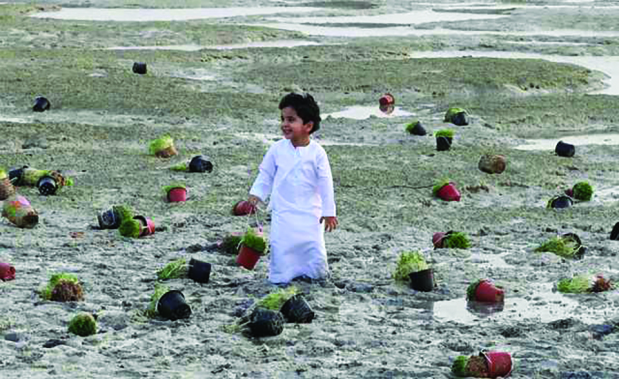
Families will once again gather on Friday to partake in an annual ancient tradition aimed at teaching young ones the joys of nurturing and patience.
The Hiya Biya event, organised by the Bahrain Authority for Culture and Antiquities (Baca), will be held at Marassi Galleria in Diyar Al Muharraq from 4pm to 6.30pm.
The event includes activities that reflect the rich heritage of Bahrain such as folk arts performances presented by the Shabab Al Hidd Band, an artistic workshop with story-telling activities and the conclusion will be the Hiya Biya practice itself.
Families will be able to participate in this event, which provides an opportunity to discover aspects of local culture in fun and educational ways, explained Baca.
Marking the end of the pilgrimage in Mecca and the Eid Al Adha (Feast of the Sacrifice) children sing a song before throwing a small plant into the sea, waving it goodbye and at the same time wishing to go to Haj one day.
The seedling is placed in a woven basket made from palm tree leaves, usually the seeds of fast-growing plants, like radishes and beans, which fish feed on once thrown into the sea.
The occasion is also celebrated in other GCC countries, especially in eastern Saudi Arabia, Oman and Qatar.
Other popular spots where local families gather include Karbabad, Tubli, Arad Fort, Barbar, Nurana and Busaiteen.
Traditional Hiya Biyas are sold from around 600 fils to BD1.500 and a selection can be found at the permanent Bahraini Farmers Market in Howrat A’ali.
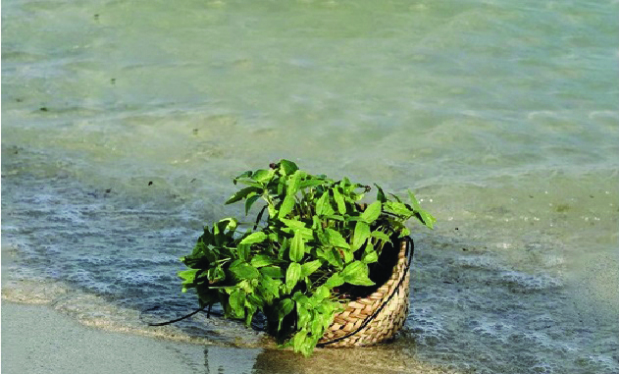
The traditional Hiya Biya
“It is just one of those traditional aspects that every Bahraini feels attached to,” Strategic Thinking Bloc president MP Ahmed Al Salloom told the GDN. “It brings us all together, regardless of age, on our seashores,” he added. “The once-a-year experience is unmatched by any other and, for many years, people from across the country, even non-Muslims, have found it fascinating and interesting. It is one of those local traditions that will continue forever.”
Retired businessman and history enthusiast Hussain Almahdi recounted his memories of growing up in 1950s south Muharraq and participating in the event. “As children, we’d grow our own Hiya Biyas in baskets made of palm fibres (singular: guffa),” the 70-year-old told the GDN. “We’d take care of the plants and water them every day, which filled us with joy too.”
He added that the sea was once a stroll away from their homes, where multiple families, including grandparents, uncles, aunts and cousins lived at the time. “All the children would go as a group to throw the sacrifices into the sea,” he recalled.
British linguist and historian Clive Holes, who has written extensively about Bahraini language and culture, suggested that the custom might have long-established roots. In a research paper, he outlined that it could be linked to similar customs belonging to Christians in Sicily and Jews in ancient Mesopotamia. It may also have ties to an ancient Greek festival mourning the death of mythological figure Adonis, which was in turn based on the god ‘Dumuzid’ or ‘Tammuz’ from Sumer, the oldest recorded civilisation in the region.
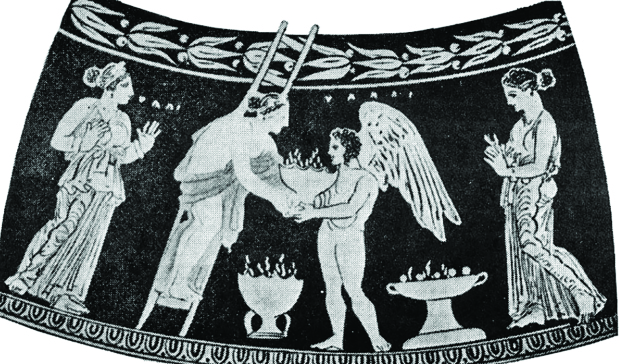
The popular Hiya Biya in historic art
In the ‘Adonia’ festival, mourners in Athens would plant fennel and lettuce seeds in clay pots and then cast them into the sea. The plants used in the ritual were regarded as the ‘Gardens of Adonis.’
Although Mr Holes had found that the tradition had fallen out of fashion a few decades ago, he noted that it has experienced a revival as part of a conscious national effort to preserve ‘popular heritage’.
Saudi literary historian Sayed Adnan Al Awami also documented an identical custom in the Eastern Province, known as ‘dokhela’.
In modern, environmentally-friendly times, the Supreme Council for Environment (SCE) has called upon families to ensure they also step back in time and use eco-friendly baskets for ‘Hiya Biya’.
The GDN reported last year that concerns had been raised over an increasing use of polluting plastic plant pots, instead of traditional palms that disintegrate.
mohammed@gdnmedia.bh
&uuid=(email))