

Bahrain has maintained its top ranking in combating human trafficking for the seventh consecutive year, according to a US State Department report released last night.
The Trafficking in Persons (TIP) Report 2024 placed Bahrain in the Tier 1 status – the only GCC country recognised as being fully compliant with the Trafficking Victims Protection Act’s (TVPA) minimum standards for elimination of human trafficking.
The 24th edition of the annual report features narratives on 188 countries and territories, and covers the period from April 1, 2023 to March 31, 2024.
US Secretary of State Antony Blinken released the report last night which states that Bahrain government ‘fully meets the minimum standards for the elimination of trafficking.’
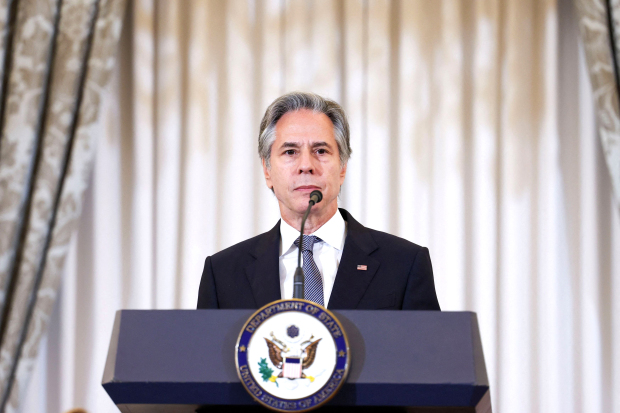
Secretary Blinken delivers remarks during the release of the report at the State Department in Washington
“The government continued to demonstrate serious and sustained anti-trafficking efforts during the reporting period; therefore Bahrain remained on Tier 1,” states the report. “These efforts included drafting, finalising and disseminating a screening form to identify trafficking victims held in detention centres pending deportation and developing a mandatory identification tool to identify potential sex trafficking victims.”
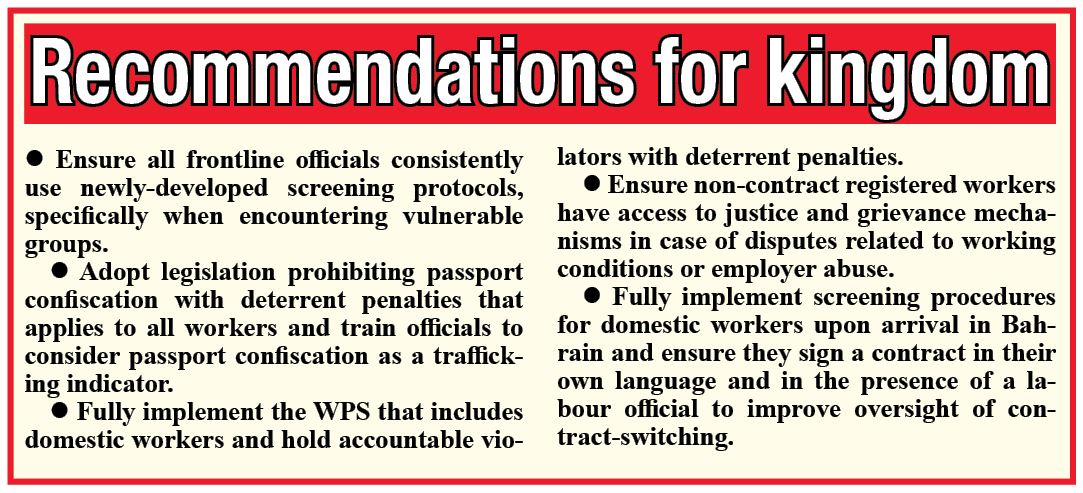
The report praises the local authorities for intensifying screening procedures for all domestic workers upon arrival at the airport to verify employment and prevent fraudulent recruitment and employer abuse.
Compares
It acknowledges that the Interior Ministry, during the reporting period, investigated 46 cases (involving 66 alleged traffickers) – 17 for sex trafficking, 27 for labour trafficking and two cases involving both. This compares with 42 cases (involving 59 alleged traffickers) – eight for sex trafficking and 34 for forced labour – in the 2022 report.
Report highlights:
Officials prosecuted 19 perpetrators, including 13 alleged sex traffickers, two alleged labour traffickers and four defendants for both sex and labour trafficking crimes; this compares with the prosecution of 19 defendants in 2022.
The government identified 22 trafficking victims, compared with 27 victims in the previous reporting period. The 22 included 15 female sex trafficking victims, three labour trafficking victims (two females and one male) and four female victims of both sex and labour trafficking.
The LMRA referred 32 potential trafficking cases to the Public Prosecution Office (PPO)’s Trafficking in Persons Unit – 31 for labour trafficking and one for sex trafficking.
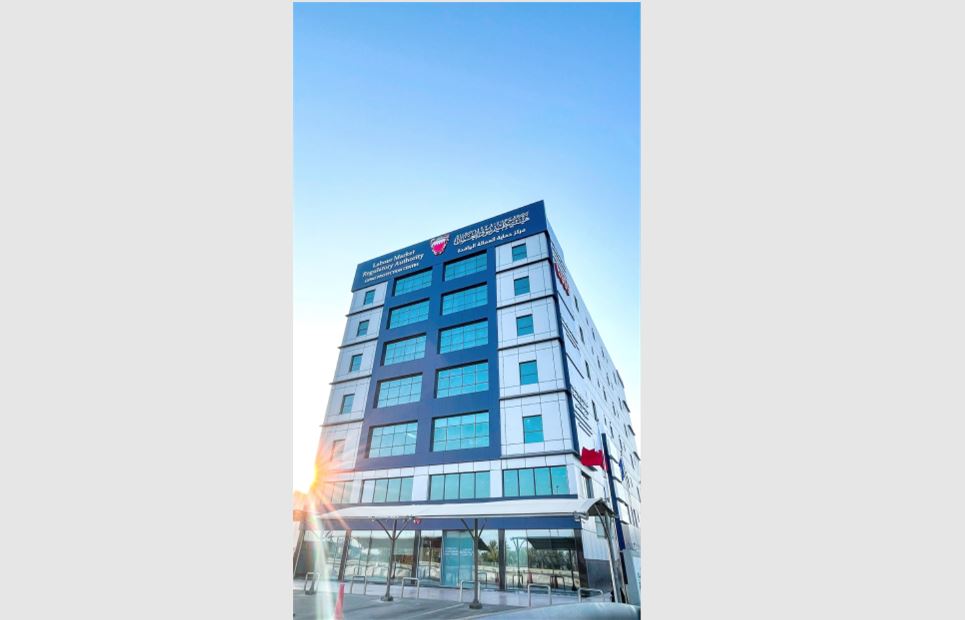
The LMRA-run Expat Protection Centre provided a wide range of services, including financial help, to trafficking victims
Courts convicted eight traffickers, including three for sex trafficking, one for labour trafficking and four for both sex and labour trafficking; this was a decrease compared with 15 convictions in 2022. All traffickers were fined and jailed for between one and 10 years.
The government reported 100 potential trafficking victims who helped in investigations; of these, 37 appeared in court proceedings.
In addition, there was no investigation or conviction of government employees.
“The government required convicted traffickers to pay all costs associated with the repatriation of victims and planned to deport all non-Bahraini traffickers upon completion of their sentences,” stated the report.
Trafficking cases were regularly fast-tracked to the High Criminal Court, bypassing the lower courts, to accelerate the justice process, according to the report.
Global recognition
Bahrain is the only Gulf country with the Tier 1 status, with four others placed in Tier 2 and Kuwait on Tier 2 Watchlist.
The kingdom has constantly moved up in the annual assessment, from being in Tier 3 in 2011 to maintaining a Tier 1 rating since 2018.
The report categorises countries into four sections as mandated by the TVPA, which is the American law against human trafficking.
Tier 1 nations fully meet TVPA standards, while Tier 2 and Tier 2 Watchlist nations do not fully comply with the minimum standards for the elimination of trafficking, though making significant efforts to do so.
Countries not complying with the minimum standards are placed in Tier 3 and subjected to certain US sanctions.
The report states that the Labour Market Regulatory Authority (LMRA) -run Expat Protection Centre in Sehla provided services to workers, regardless of their gender or legal status, including shelter for potential trafficking victims. The centre provided separate spaces for men, women and children with a maximum capacity of 400 individuals.
The government allocated BD197,191 for victim protection and assistance.
“The centre provided victims and potential victims with shelter, food, clothing, medical care, religious support, psycho-social care, transportation, familial reunification, translation services and legal counsel,” states the findings.
However, potential trafficking victims were ineligible for the Victim Assistance Fund without an official confirmation by the Public Prosecution.
Allowance
“The government provided all official trafficking victims who remained in Bahrain for the duration of their trial with BD1,131 in assistance in addition to a monthly allowance of BD93 via its Victim Assistance Fund,” the report said.
It explained that embassies also provided housing on a temporary basis to potential victims who decided not to stay at the government-run shelter.
The government provided assistance, including shelter, to 44 potential trafficking victims, offered job placements in the kingdom (two victims of labour trafficking were issued new work permits) and repatriated 16 victims during the reporting period. Authorities also allocated BD1,385,213 for anti-trafficking efforts.
Bahraini authorities “provided comprehensive protective assistance to all official victims regardless of their willingness to participate in criminal justice proceedings and relieved them from all legal and financial penalties related to acts committed as a direct result of being trafficked.”
The report explained that the government-run national trafficking hotline (995) received 851 calls during the year, while the Interior Ministry hotline received 138 calls and identified two potential trafficking cases that were referred to the Prosecution.
Observers reported that multilingual hotline at times went unanswered and did not provide services in Tagalog, despite many Filipinos living in Bahrain.
The report noted that the LMRA:
* Retrieved (from employers) and returned 1,719 passports to migrant workers last year.
* Deported 5,477 violating workers identified during joint inspections by the LMRA and the Interior Ministry.
* Inspected 402 recruitment agencies and 371 employment offices; these resulted in the closure of one manpower firm that was referred to prosecution.
* Non-and delayed-payment of wages continued to be common practice; the LMRA reported it received 1,064 claims of unpaid wages from workers during the year. In 2023, workers reported wage thefts of between one and five months.
Another issue mentioned was non-payment of wages to expats despite the Wage Protection System (WPS), which mandates bank transfer of salaries by companies. It does not cover domestic workers though 65,491 companies (with 589,003 workers) have signed up to the system.
The annual assessment states that as reported over the past five years, men and women, primarily from India, Bangladesh, Cameroon, Kenya, Pakistan, the Philippines, Nepal, Egypt, Sri Lanka, Jordan, Uganda, and Yemen, among other countries, migrate voluntarily to Bahrain to work as semi-skilled or unskilled labourers in the construction and service industries and domestic work sector.
Officials stated that there were approximately 78,900 domestic workers as of February this year – 85 per cent of whom were female, predominantly from the Philippines, Ethiopia, India, Indonesia, Kenya, Pakistan, and Sri Lanka.
“Domestic workers from African countries are increasingly at risk of labour trafficking and arrive in Bahrain via direct recruitment by local employers, in which workers pay brokers or middlemen in their home country to match them with a visa sponsor in Bahrain,” said the report.
“Reports increasingly indicate traffickers in countries of origin deceptively recruit skilled workers – including doctors and teachers, mostly from Africa – and upon arriving in Bahrain, force them into domestic work.
“Traffickers recruit women to Bahrain via social media platforms or Bahrain-based acquaintances under false pretences of high-paying jobs in the hospitality and domestic work sectors and subsequently force them into sex trafficking.”
The use of digital platforms by criminals was also highlighted by Secretary Blinken in the report as he said these tools have amplified the reach, scale, and speed of trafficking.
“Perpetrators use dating apps and online ads to recruit victims,” Blinken said. “At the same time, technology is also one of our most powerful tools to combat this enduring scourge.”
sandy@gdnmedia.bh
&uuid=(email))