

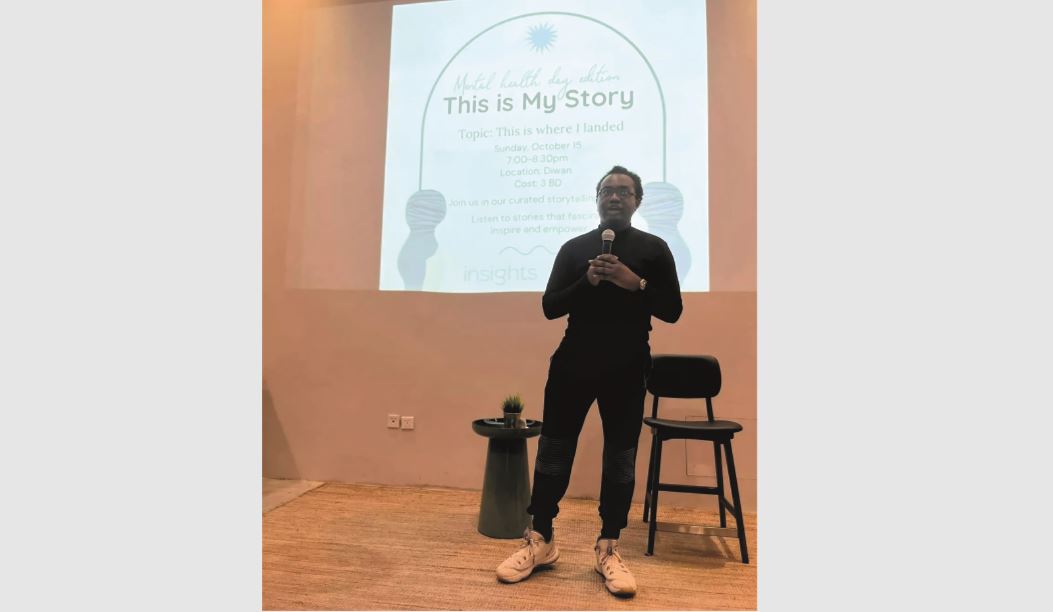
Mental health activist and public speaker Ashraf El Tahir, 20, is aiming to help people overcome their mental health challenges by speaking about his own struggles at his first ever event next month.
He also hopes to make information about how to seek treatment more accessible to people.
“At just 18 years old I was diagnosed with schizophrenia, depression and obsessive compulsive disorder,” said the Saudi-born expatriate of Sudanese descent who moved to Bahrain 14 years ago.
“I have struggled with mental health since my earliest memories due to an unstable childhood, and the older I got, the harder it was to deal with,” he added.
Loss of motivation, anger and intrusive thoughts were among the most difficult emotions he experienced, which he claimed ‘took him into a spiral’. This resulted in him receiving treatment at Salmaniya Medical Complex for more than 30 days.
He has also received treatment from other hospitals in Bahrain.
“The most difficult aspect was dealing with all of these emotions and feelings, but I was afraid to reach out, and wasn’t sure how to,” he said, adding that he feels for those who are currently struggling and don’t know how to reach out.
According to PwC Middle East, around 15 per cent of the GCC’s population suffers from mental health and illness, but only a minority of those in need sought care.
PwC Middle East is an organisation that uses technology and expert capabilities to deliver reports about the region’s major issues, as well as offering tax, assurance, strategy, advising and consultancy services. The latest report highlights that stigma towards mental health remains a major barrier to accessing care in the region. Untreated mental illness costs the region billions of dollars a year in lost productivity, according to the company’s estimates.
It also reported that there were only 2.85 psychiatrists for every 100,000 people in the GCC, which compares to eight for every 100,000 in the UK.
According to a large-scale study co-led by researchers from Harvard Medical School and the University of Queensland, one out of every two people in the world will develop a mental health disorder in their lifetime.
“I see a lot of young people struggling with their mental health, but unfortunately cost and stigma are among the reasons why people don’t seek that help,” Mr El Tahir said, adding that mental health services should be more affordable and accessible so people from all walks of life can receive it.
“The treatment I received taught me the skills to be able to cope with my own mental challenges, and I encourage everyone thinking of reaching out to do it.”
He highlighted four steps that helped him overcome his darkest days. They were seeking help, realising you deserved a second chance, having hope and never giving up.
Mr El Tahir will be speaking at an event, titled Turning Life’s Misfortunes into Fortunes’ with a clinical psychologist, Lujain Yaser, on August 2 at a co-working space in Manama, Diwan. They will discuss their own experiences with mental health as well as information about how to tackle the challenges.
- For more information about the event, check out @Ashthecoffeemonk on Instagram.
julia@gdnmedia.bh
&uuid=(email))