

A senior Lebanese official has signalled that Hizbollah is ready to pull its forces away from the Lebanese-Israeli border in any ceasefire, while rejecting Israel’s demand for freedom to act against the Iran-backed group in Lebanon in the future.
An Israeli minister indicated that a ceasefire was closer than at any point since the war began, though he said a sticking point was ensuring Israel retains freedom to act inside Lebanon should any deal be violated.
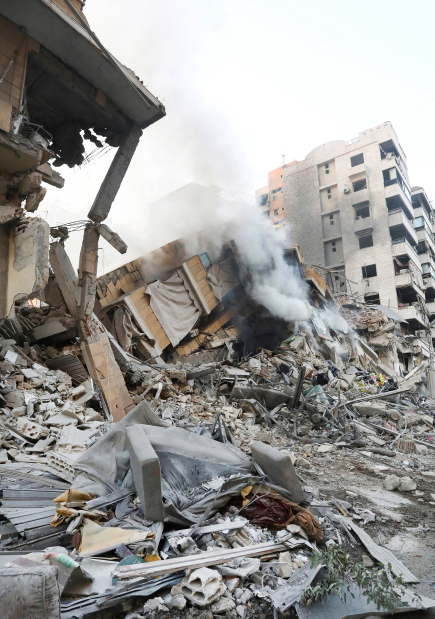
Pressing its offensive against the Iran-backed group, Israel launched airstrikes on Beirut’s Hizbollah -controlled southern suburbs yesterday, keeping up its unusually intensive bombardment of the area for a third consecutive day.
Israel has dealt Hizbollah heavy blows since launching its offensive in late September, escalating the conflict that had rumbled on in parallel to the Gaza war for a year. Hizbollah has kept up rocket fire into Israel and its fighters have been battling Israeli troops on the ground in the south.
A World Bank report estimated the cost of physical damage and economic losses due to the conflict in Lebanon at $8.5 billion – a massive price for a country still suffering the effects of a financial collapse five years ago.
Senior Lebanese official Ali Hassan Khalil said Lebanon was ready to ‘precisely’ implement UN Security Council resolution 1701, which ended a 2006 war between Israel and Hizbollah .
Its terms require Hizbollah to remove fighters and weapons from areas between the border and the Litani River, which runs about 30 km from Lebanon’s southern border.
Asked whether Hizbollah had informed him of a readiness to withdraw to the Litani, Khalil - a close Hizbollah ally and top aide to Lebanon’s parliament speaker - said the group had expressed its commitment to Resolution 1701.
The resolution, he added, “contained a clear set of provisions”. “Yes, the party is committed to what is stated in these texts,” he said, referring to Hizbollah .
The United States and other powers say a ceasefire must be based on Resolution 1701.
Israel long complained it was never implemented, pointing to Hizbollah weapons and fighters at the border. Lebanon in turn accused Israel of violating the resolution, with Israeli warplanes regularly violating its airspace.
Eli Cohen, Israel’s energy minister and a member of its security cabinet, said: “I think we are at a point that we are closer to an arrangement than we have been since the start of the war”.
A key sticking point for Israel, he said, is ensuring it retains freedom of action should Hizbollah return to border areas.
“We will be less forgiving than in the past over attempts to create strongholds in territory near Israel. That’s how we will be, and so that is certainly how we will act,” he said.
Earlier this week, White House envoy Amos Hochstein, who has led several fruitless attempts to broker a ceasefire, told Axios he thought ‘there is a shot’ at a truce in Lebanon soon. It points to a last-ditch effort by the outgoing US administration to seal a Lebanon deal, with diplomacy to end the Gaza war adrift.
Khalil said Lebanon had no objection to US or French participation in overseeing ceasefire compliance.
Meanwhile, plumes of smoke rose over the southern Beirut suburbs known as Dahiyeh, where Israel’s latest strikes destroyed five buildings.
The Israeli military said its fighter jets carried out a series of attacks in the southern Beirut area, targeting weapons warehouses, military headquarters and other infrastructures used by Hizbollah .
“We say God help us ... because it seems that things are developing, it is getting worse, and I don’t even know if there is a solution now,” said Ayat, a 33-year-old Lebanese woman.
According to Lebanon’s health ministry, Israeli attacks have killed at least 3,365 people and wounded 14,344 across Lebanon since October 7, 2023.
&uuid=(email))