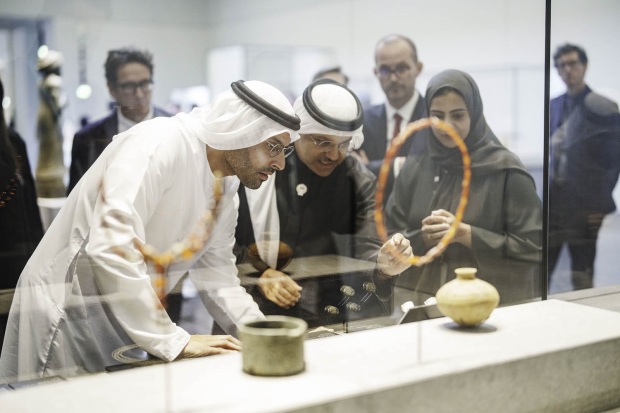
A collection of Bahraini archaeological discoveries dating back to the Dilmun and Tylos periods are being exhibited at the world-renowned Louvre Abu Dhabi in the UAE.
The Bahraini artefacts will be on display until June 2026, as part of the recently signed collaboration agreement between the Bahrain Authority for Culture and Antiquities (Baca) and Louvre Abu Dhabi.
“We take great pride in our collaboration with Louvre Abu Dhabi and in showcasing Bahraini artefacts at the first universal museum in the Arab world.” Baca president Shaikh Khalifa bin Ahmed bin Abdulla Al Khalifa said during a recent visit to Louvre Abu Dhabi.

One of the Bahraini artefacts on display at Louvre Abu Dhabi
“Hosting these artefacts underscores the importance of collaboration between cultural institutions in the Gulf region to promote the narratives of the civilisations that once thrived there.
“This achievement is a testament to the shared dedication of Bahrain and the UAE to promoting our collective history and heritage.”
The pieces will offer visitors a unique opportunity to engage with the region’s heritage and explore the historical contributions that have shaped the identity of the Arabian Gulf over the centuries.

Dignitaries and guests during the visit to Louvre Abu Dhabi
The collection includes a Tylos-period tombstone, an early Dilmun strainer jar, and two Dilmun seals.
The seals were essential to commercial life, serving as symbols of ownership and social status. Expertly crafted from stone or marine shells, the seals reflect the artistic traditions of the Dilmun period, which continues to influence art today.

The Dilmun seals on display
The filter jar stands as a testament to early craftsmanship, showcasing how craftsmen of the period skillfully blended clay with limestone to produce pottery that was both functional and aesthetically distinctive..jpg)
The Dilmun filter jar
Pottery-making remains one of the most enduring legacies of Dilmun culture, with its techniques still practised today in Bahrain’s traditional crafts.
Sculpture during the Tylos period evolved significantly through interactions with the Hellenistic culture, a connection reflected in the tombstone displayed at Louvre Abu Dhabi.
During his visit, Shaikh Khalifa was received by Louvre Abu Dhabi and Abu Dhabi culture and tourism department chairman Mohamed Khalifa Al Mubarak and Louvre Abu Dhabi director Manuel Rabaté, who accompanied him on a tour of the Bahraini artefacts.
“This celebration of our roots fosters pride in younger generations and ensures that our heritage is a living part of our present,” Mr Al Mubarak noted.
naman@gdnmedia.bh