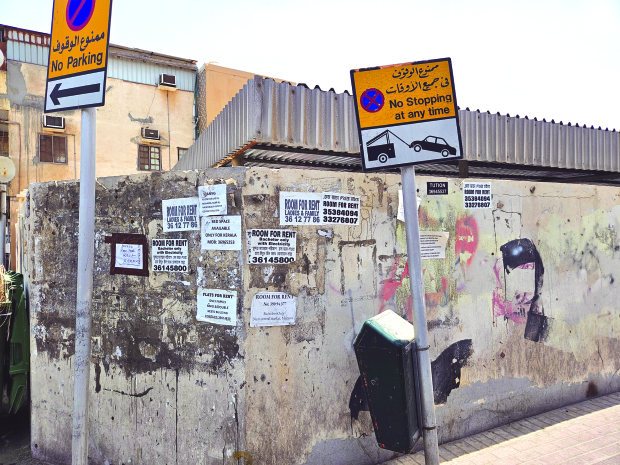
A CRACKDOWN on illegal flyposting is being launched in Bahrain’s capital as part of a wider campaign to preserve the aesthetic appeal and cleanliness of urban spaces.
The Capital Trustees Board has announced strict penalties as the campaign targets visual pollution in expatriate-heavy areas.
The move aims to eliminate the widespread issue of unauthorised posters being pasted on the walls of residential and public properties by penalising all of those involved.
While the problem has seen a noticeable decline in recent years – largely due to the rise of digital platforms – certain parts of the capital, particularly expatriate-dominated areas, continue to suffer from the unsightly practice.

Mr Tarradah
Board chairman Saleh Tarradah has directed that the crackdown be accompanied with a campaign to raise awareness, in multiple languages, of fines of up to BD300.
“Adverts are still being pasted on walls, windows and doors of public and private properties in several parts of the capital as some individuals find this easier than using social media platforms,” said Mr Tarradah.
“This not only affects the appearance of our neighbourhoods, but also sends the wrong message about public respect and order.”
He acknowledged that one of the major obstacles to effective enforcement is identifying the individuals responsible.
“People behind these posters always say they assigned the job to someone else, and when we approach others, they claim someone else handled it. This cycle of blame complicates enforcement,” he explained.
However, Mr Tarradah announced a new policy of shared accountability, under which all parties linked to flyposting will be held liable.
“Everyone involved will be penalised and they can figure out who will pay the fine,” he said.
“We will no longer tolerate this behaviour, and all those responsible – regardless of whether they physically put up the poster or ordered it – will face penalties.”
To offer a practical solution, Mr Tarradah highlighted that several supermarkets and hypermarkets across the capital have already installed designated notice boards where individuals can post advertisements for a minimal fee.
“These are legal, affordable and accessible alternatives that ensure people can promote their services without defacing private or public property,” he said.
“We hope that imposing penalties and promoting lawful alternatives will gradually phase out the practice, ensuring our urban spaces remain clean and visually appealing.”
Mr Tarradah called on residents to actively participate in the campaign by refraining from posting unauthorised flyers and reporting violators to the relevant authorities.
“With both awareness and enforcement, we aim to put an end to this menace. Residents have a role to play – this is about civic responsibility as much as it is about regulation.”
The board’s technical committee chairwoman Huda Sultan echoed the chairman’s sentiments, describing flyposting as ‘a form of silent vandalism’ that undermines efforts to beautify public spaces.

Ms Sultan
“We spend time and resources enhancing the appearance of our neighbourhoods, only to see walls and gates plastered with phone numbers and advertisements overnight,” said Ms Sultan.
“This is not a question of visibility for services, it’s a matter of respecting shared community spaces.”
She stressed that the technical committee fully supported the crackdown and will work with authorities to ensure that rules are enforced across all parts of the capital.
“This is a behavioural issue that requires both deterrence and public awareness. We are confident that with the right enforcement and community support, we can eliminate flyposting entirely.
“As Bahrain continues its push toward smarter, cleaner urban environments, we hope that combining enforcement with public engagement and digital innovation will mark a decisive end to illegal flyposting, restoring the integrity of the kingdom’s urban landscape.”
mohammed@gdnmedia.bh