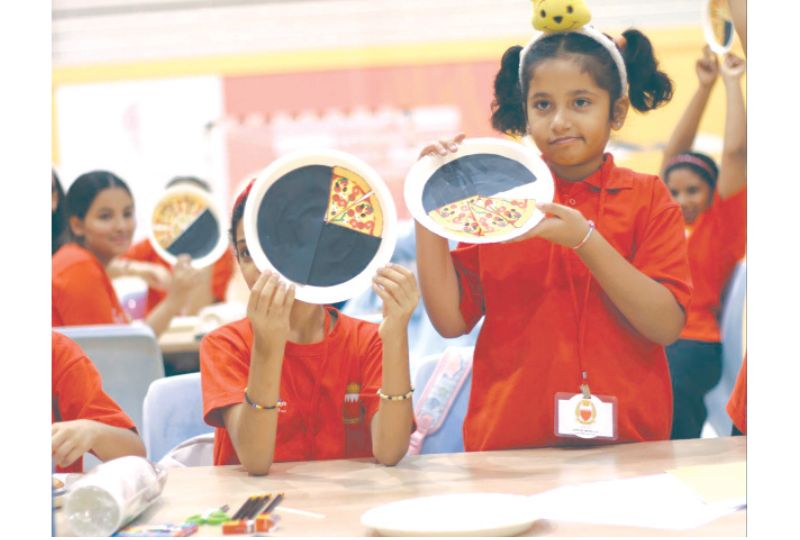
A NATIONAL platform advocating for responsible food consumption has highlighted big plans for the second phase of its operations, which focuses on systemically onboarding more young individuals to support the cause.
The announcement coincides with International Day of Awareness of Food Loss and Waste today, an annual event to promote efforts to reduce food loss and waste as a critical element of securing a sustainable food future for all.
A My Clean Plate volunteer guiding members of the Boys Scouts of Bahrain during a previous event
Launched three years ago by a group of young volunteers, My Clean Plate, a national campaign against food waste, has been made an official part of the primary section and high school curricula in public and private Arabic schools. There are plans to expand to the university level as well.
Additionally, the group is set to release a new children’s book that brings alive interactions in a restaurant and at home, offering valuable lessons in not wasting food. The story will soon be available in school libraries and can be directly purchased from My Clean Plate – all proceeds go towards the campaign. The first book was published in 2022.
Ms Fareed
“The first phase was more about finding the right partners and now that we have, we want to embed the movement into the system and community,” My Clean Plate founder Aisha Fareed told the GDN.
“We are now focusing on long-term goals – having a law in place for food wastage in restaurants, for instance – and are definitely on the way to achieving them.
“My Clean Plate is now an official chapter in the textbooks under environmental studies. Schools have already started to create their own voluntary groups for the programme as a requirement under the curriculum.
“Additionally, we have already submitted proposals to some universities to involve students in environmental studies,” she noted.
Global statistics according to the UN
- An estimated 13 per cent of food – the equivalent of 1.25 billion tonnes – was lost globally after harvest and prior to reaching retail shelves in 2021.
- An estimated 19pc of food – the equivalent of 1.05bn tonnes – was wasted in households, food service and retail in 2022.
- Households account for 60pc of global food waste.
- Approximately 28.9pc of the global population – 2.33bn people – were moderately or severely food insecure in 2023.
- One out of 11 people in the world faced hunger in 2023.
- Food loss and waste generate eight to 10pc of global greenhouse gas emissions.
The campaign is officially supported by the Youth Affairs Ministry under the Badir programme, which supports independent research projects and innovative solutions in Bahrain.
In the past, numerous activities have been staged under the campaign targeting students from different age groups, as highlighted in a previous GDN report, including storytelling and interactive events, working closely with parents to establish a rewards system for donating usable leftovers and other creative competitions.
Furthermore, the campaign aims to ensure Bahrain is no longer in the top-10 food wasting countries by 2030.

Ms Al Dhaen
“More than 400 tonnes of food gets wasted in Bahrain every day and it is on the rise as hotels, supermarkets and restaurants continue to oversupply in order to maintain customer satisfaction,” Conserving Bounties Society chief executive Thawra Al Dhaen revealed.
“Bahrain is reaching full capacity in terms of waste management, with the Askar landfill already exceeding its projected capacity and lifespan. This alarming reality highlights the urgent need to address the growing problem of food waste,” she added.

A page from the chapter on food waste included in the school textbooks
The society, which operates the Bahrain Food Bank, is collaborating with InterContinental Bahrain, as part of IHG Hotels and Resorts’ global ‘Giving for Good’ initiative, which supports causes that make a positive impact in the community.
As part of this collaboration, the culinary team and chefs at the hotel will prepare 1,000 meals, which the volunteers will pack in food containers to distribute among beneficiaries.
“At Conserving Bounties, we do not confine our efforts to a single day or event. Instead, our work to combat food waste continues throughout the year. Every day, we carefully collect surplus edible food, pack it with care and distribute it to families and individuals who need it,” Ms Al Dhaen noted.
According to the UN Environment Programme’s Food Waste Index, people in Bahrain threw away 146,000 tonnes of food in 2020, costing the country BD94.9 million. In terms of food waste alone, Gulf countries create about 45m tonnes per year.
melissa@gdnmedia.bh