

.jpg?20260428')
Climate change could have a drastic impact on public health in Bahrain in the coming years, as rising temperatures are likely to cause heat stress, worsening cardiovascular health and a rise in infectious diseases.
This is among the key findings of a recent Bahraini study titled ‘Rising Temperatures and Potential Effects on Human Health in the Kingdom of Bahrain: A Call for Action’, conducted by Arabian Gulf University researchers Ghadeer Kadhem and Sabah Aljenaid, in collaboration with University of Bahrain associate professor Humood Naser, and published in the peer-reviewed, open-access ‘Earth’ journal.
“Sustainable development is increasingly challenged by the growing threats of climate change,” the researchers noted in the abstract of the study.
“There is a close relationship between climate change, public health, and Sustainable Development Goals (SDGs). This study investigates the temperature anomalies in Bahrain and their potential effects on human health. Furthermore, it proposes solutions to support Bahrain’s SDG-related goals.”
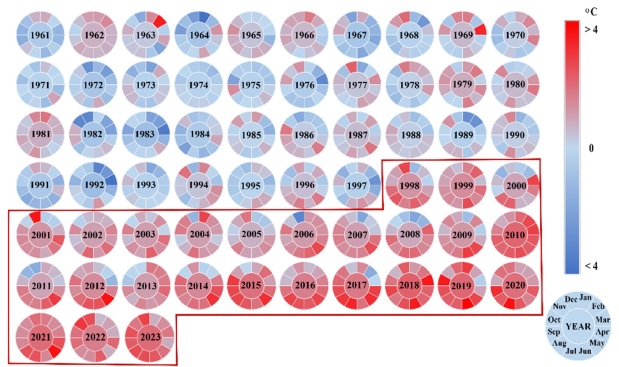
Monthly temperature anomalies in Bahrain from 1961 to 2023, with radio chart sections representing months, and the centre illustrating years. Red indicates months and years with higher anomalies, while blue indicates months with lower anomalies compared to the mean temperatures of the base years. The red box highlights the period from 1998 onward, marking a clear and sustained shift towards predominantly warmer conditions
Based on more than 50 years of meteorological records from Bahrain, combined with global climate and health data, the study concluded that the kingdom is heating up at an alarming pace, with average temperatures rising between one and four degrees Celsius compared to the 1960s, 1970s and 1980s.
Summers in recent years consistently fall into what experts call the ‘extreme danger’ category of the heat index - a measure that combines heat and humidity to indicate how hot it feels to humans.
According to the study, Bahrain’s humid summers pose life-threatening risks.
Since 2000, Bahrain has regularly recorded maximum temperature anomalies above one degree, and in the peak summer of June 2019, anomalies spiked by four degrees compared to historical averages. As researchers put it, ‘hotter years have become more frequent since mid-1997.’
With humidity levels averaging more than 68 per cent, the combination of heat and moisture leaves the population exposed to relentless thermal stress.
Cardiovascular
The Bahraini study highlighted a direct relationship between temperature anomalies and cardiovascular disease.
Regression analysis revealed that each increase in local temperature anomalies corresponded with a measurable rise in the incidence of cardiovascular conditions.
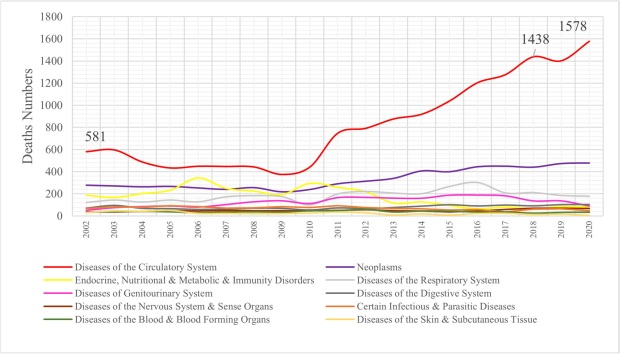
Number of deaths by disease types in Bahrain from 2002 to 2020
“It is noteworthy that the official data for Bahrain shows that the number of deaths resulting from circulatory and heart diseases, despite the improvements in health and awareness services, are more prevalent than any other cause of disease-related deaths in Bahrain,” researchers added.
“The number of deaths caused by circulatory and heart diseases at the beginning of the 2000s did not exceed 581. By 2018, this number had tripled to around 1,438, and in 2020, it reached 1,578. These statistics correlate with high temperatures and humidity levels in Bahrain, suggesting they may be significant contributing factors to such health conditions.”
The researchers emphasised that high temperatures and humidity can trigger heatstroke and worsen existing illnesses such as hypertension, diabetes and asthma.
Medical experts in other countries have also begun to frame climate change as a medical crisis.
The British Cardiovascular Society, for example, has warned that extreme heat is likely to fuel strokes, heart failure and higher mortality rates.
Heat Stress
Elderly people, young children and those already living with chronic illnesses are most vulnerable to the effects of extreme heat.
Manual workers, especially those employed in outdoor construction or services, face particular dangers.
Bahrain has attempted to reduce these risks by banning outdoor work between noon and 4pm from June 15 to September 15, when the heat is most intense.
Researchers noted that while this step is important, more comprehensive measures are urgently needed, arguing that Bahrain’s health statistics do not currently capture heat-related morbidity and mortality in detail.
The absence of such data makes it difficult to design targeted interventions or measure the full burden of climate change on public health.
According to the study, GCC countries are among the most exposed in the world to rising heat-related mortality.
Projections suggest that deaths caused by non-optimal temperatures in the GCC could rise from around four per 100,000 people in 2030 to as high as 65 per 100,000 by 2090.
The combination of a hyper-arid climate, rapid urbanisation and heavy reliance on fossil fuels makes the Gulf particularly vulnerable, and Bahrain’s small size and dense population amplify the risks.
Mosquitoes
Beyond the cardiovascular impact, rising heat and humidity are fuelling another concern.
Mosquito populations have been increasing, creating conditions for the spread of infectious diseases.
Surveys conducted between 1997 and 2019 revealed a growing number of active mosquito breeding sites carrying disease-transmitting species.
In 2019 more than 12pc of examined sites were positive, compared to only 2-3pc in the late 1990s.
Bahrain has eliminated local malaria transmission in recent decades, but the researchers caution that this progress is at risk of reversal.
Warmer and wetter conditions create an environment where mosquitoes can thrive year-round, raising the possibility of reintroducing malaria or sparking outbreaks of diseases such as dengue or Zika.
The World Health Organisation has repeatedly warned that climate change is expanding the geographic range of such vector-borne diseases, and Bahrain’s climate profile now fits the conditions in which they spread most efficiently.
Recommendations
To respond to these threats, researchers are calling for the introduction of a national heat-health warning system that can alert vulnerable groups when temperature and humidity reach dangerous levels.
They also recommend awareness campaigns in schools, universities and workplaces about the symptoms of heat stress and how to respond.
Legislation should be expanded to limit children’s exposure to heat during outdoor activities, mirroring the protections already afforded to outdoor workers.
The study is also recommending intensified mosquito monitoring and eradication campaigns, as well as research into how changes in temperature and humidity are affecting mosquito behaviour.
Researchers emphasise that climate-health strategies must be integrated into Bahrain’s broader development agenda, with closer regional cooperation among GCC countries
At the landmark UN Climate Change Conference (COP26) held in 2021 at Glasgow, UK, His Royal Highness Prince Salman bin Hamad Al Khalifa, Crown Prince and Prime Minister, stressed the importance of adapting to climate change.
The kingdom has committed to reaching net zero by 2060, with a number of interim goals to be hit by 2035, including reducing emissions by 30pc through decarbonisation and efficiency initiatives, quadrupling mangrove coverage, doubling tree coverage, and directly investing in carbon capture technologies.
These goals, if achieved, will help slow climate change, cool urban areas, improve air quality and protect ecosystems.
This can reduce the severity of heat stress, ease pressure on cardiovascular health, and limit conditions that allow mosquito-borne diseases to spread, and must be paired with stronger health monitoring and public awareness to fully address risks.
naman@gdnmedia.bh
&uuid=(email))