The International Committee of the Red Cross (ICRC) is facing a funding crunch, despite ongoing generous support from the GCC, at a time when the need for humanitarian assistance in a conflict-riddled world appears overwhelming, according to a top executive from the not-for-profit organisation.
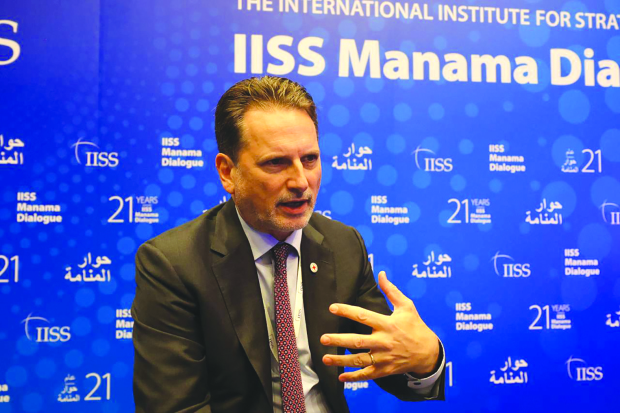
ICRC director-general Pierre Krähenbühl spoke with the GDN on the sidelines of the 21st International Institute of Strategic Studies (IISS) Manama Dialogue, which concluded yesterday at the Ritz-Carlton Bahrain.
“About 85 per cent of our funding in the ICRC comes from states or multi-state and multilateral organisations,” he explained. “What we are trying is to stabilise that and to expand the basis of these donors. So, for example, the Gulf has been very responsive to that, I must say, we are really seeing a response there, and we want to build on that and expand further.
“We’re very grateful for the fact that all of the GCC states support our work financially and that enables us to carry out, of course, the activities not only in Gaza, but beyond, and that is important, so we appreciate that very much.
“We also recognise that in the specific case of Qatar, there has been direct involvement in the mediation effort. We have worked closely with Qatar and with Egypt on those aspects, because we wanted to bring the humanitarian considerations to the discussions, especially about the question of the hostage and prisoner release and, of course, of the issue of mortal remains.
“And, in that sense, that is probably the newest part of the work that we’re currently carrying out. So that influence has been very important to us, and we really appreciate it.”
Mr Krähenbühl also revealed that two years ago, the organisation had to reduce its budgets by 700 million Swiss francs (BD327m) and is currently preparing for another reduction next year.
He noted that there was a global tightening when it came to funding humanitarian efforts, and also, the nature of conflicts had changed, leading to the need for ongoing humanitarian support.
“For about 25 years we had dealt with mostly conflicts that were between states and non-state armed groups – so-called counter-terrorism wars,” he explained. “And now what we have seen, most notably the case with the conflict between Ukraine and the Russian Federation, we have a return of the wars between states. Because these conflicts last a long time we cannot only deal with an emergency response, because it’s just an ongoing cycle of food distribution and medical aid which you have to repeat every year.
“The people also expect something different. They want their dignity to be preserved and their resilience to be supported.
“The paradox is that at the same time as the wars are proliferating – and we’re talking about these numerous violations of international humanitarian law – many of the donors are actually reducing their contributions to the humanitarian field because of pressures on their national budgets.”
Mr Krähenbühl also noted that with new technology being used in wars – the superimposition of the physical theatre of war and the digital dimensions – including drones and artificial intelligence – humanitarians have also had to keep up and actively learn about them since it’s changing the way aid has to be delivered and introducing new challenges.
The Gaza conflict, for example, has been a challenge for the organisation, which has been barred by Israeli officials from visiting Palestinian prisoners to ensure they were living in humane conditions.
“For the last two years, since October 7, Israel has not granted us access to the places of detention with Palestinian prisoners, something we had been doing for decades.”
Last week, Israeli Defence Minister Israel Katz renewed the ban claiming that the visits ‘endangered state security’.
The ICRC has been instrumental in on-the-ground relief efforts during the conflict, most recently helping with the transfer of Israeli hostages and Palestinian detainees who were released as part of a ceasefire agreement between Hamas and Israel.
“Right now, we have a lot of emergency-related needs, because the people don’t have access to enough food, there’s simply not enough medical support and the water supplies are very, very problematic still,” Mr Krähenbühl added.
“The scale of the destruction is such that it will be years to rebuild, so right now, we’re just very focused on providing emergency aid.”
naman@gdnmedia.bh