

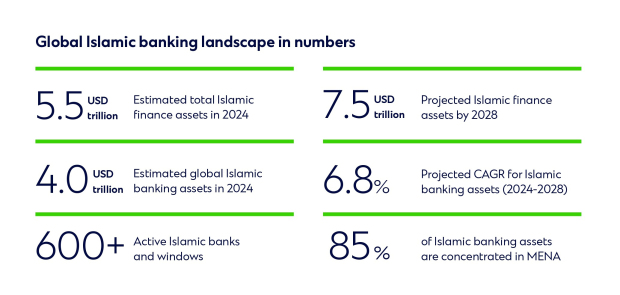
Islamic banking, now a mainstream financial segment with assets exceeding $5 trillion, faces hurdles in corporate engagement due to a lack of product familiarity, according to a report published by Standard Chartered.
The report, ‘Islamic Banking for Corporates: Broadening Horizons,’ states that 65 per cent of interested corporates have no prior exposure to Sharia-compliant solutions. This knowledge gap is restricting access to the global Islamic finance asset pool, which is projected to reach $7.5trn by 2028.
The study highlighted that while corporate sukuk issuance volumes rose 38pc to $58.8 billion in 2024, this growth could be significantly higher if more companies understood the principles, structures, and market dynamics of Islamic finance.
“Islamic banking has evolved into one of the world’s fastest-growing sources of capital, but awareness amongst corporates has not kept pace,” said Standard Chartered Group Islamic Banking chief executive officer Khurram Hilal. “This knowledge gap reflects an increasingly expensive opportunity cost.”
The report noted that Islamic finance principles align closely with ESG frameworks, driving strong investor demand. Sustainable sukuk, for example, were oversubscribed by an average of 4.3 times their issuance value in 2024, compared to 3.1 times for regular sukuk.
Digital innovation is accelerating momentum, with tokenised sukuk, blockchain settlements, and AI-enabled Sharia-compliance tools set to transform capital management and reduce issuance costs.
Islamic finance provides strategic access to critical trade corridors, particularly the GCC, Southeast Asia, South Asia, and Africa. Sharia-compliant finance underpins much of the $5.7trn South-South Corridor, which now accounts for nearly a quarter of global trade. The halal economy alone represents a $2.2trn market opportunity.
Standard Chartered, through its global Islamic banking franchise Standard Chartered Saadiq, operates in over 30 markets and has arranged more than $200bn in Islamic financing.
&uuid=(email))