

A landmark government bill modernising Bahrain’s policing framework has been unanimously approved by the Shura Council.
The sweeping legislation has been formally referred to His Majesty King Hamad for ratification, marking the most comprehensive overhaul of the Public Security Forces Law since its introduction in 1982.
The bill, which replaces the term ‘Public Security Forces’ with the more contemporary ‘Bahrain Police’, was endorsed yesterday following extensive debate and interventions from senior government officials, legislators and committee members.
It also introduces significant reforms to the Police Assistance Fund, extending eligibility to civilian personnel working in ministry divisions.
Shura Council chairman Ali Saleh Al Saleh said the new legislation comes days before Bahrain Police Day, which will be celebrated on December 14.
Interior Ministry Under-Secretary for Legislative Affairs Rashid Bunajma said the ministry ‘has already witnessed major revamps and will witness more’, emphasising that the amendments were forward-looking and rights-enhancing.
“Police teams will always improve to protect safety and security,” he said.
“These amendments won’t diminish the rights of ministry employees – they will enhance them. Civilian and police employees will now benefit from the support fund, which will be financed by small monthly employee contributions and through fines from specific violations. The fund will help employees in emergencies.”
Mr Bunajma added that the updated legal framework clearly places organisational responsibilities within the ministry.
“The minister will determine job descriptions. Work, promotions and orders are Interior Ministry’s responsibilities,” he added.
Justice, Islamic Affairs and Endowments Minister and acting Parliament and Shura Council Affairs Minister Nawaf Al Maawda reiterated that the law establishes positions and structures, while the operational authority rests with the Interior Minister.
“The minister will determine job descriptions, the law simply outlines the posts,” he said.
The Shura Council voted unanimously to approve the government-drafted bill, following a detailed report by the foreign affairs, defence and national security committee.
Committee chairman Dr Ali Al Rumaihi described the reforms as ‘a vital step towards strengthening Bahrain’s security institutions and aligning policing practices with contemporary administrative and legal standards’.
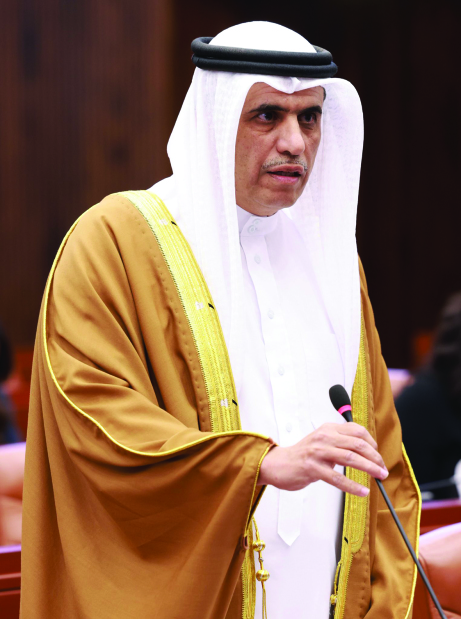
Dr Al Rumaihi
Dr Al Rumaihi praised Bahrain’s long policing tradition and emphasised the kingdom’s exceptional record.
“We are used to living in security, some countries suffer from high crime rates due to weak security structures, but Bahrain’s institutions are strong despite the unfair criticism from some organisations,” he said.
He also highlighted the success of Bahrain’s open-prison and alternative sentencing programmes.
“These programmes have achieved outstanding results – repeat offenders are below two per cent and success stands at 97pc.”
Committee rapporteur Dr Bassam AlBinmohammed said the bill ‘aims to keep pace with administrative and legal developments’.
He noted that the law updates countless terms, job titles and classifications – including replacing ‘military cadet’ with ‘officer candidate’ – and expands the categories included within the police force.
“The legislation enhances organisational readiness, strengthens performance and aligns policing frameworks with institutional development needs, modern structures and human capital investment,” he said.
“The committee found strong justification for expanding assistance mechanisms to dedicated civilian employees who play key roles in internal security. This reflects fairness and the reality of integrated teamwork inside the ministry.”
A major highlight of the bill is the introduction of a modern promotions system:
n Officer promotions will require criteria set by the Interior Minister and will be issued by Royal Order, following recommendations from the High Committee for Officers.
n Promotions for non-commissioned officers and personnel will be issued by the Chief of Police.
The bill abolishes outdated bodies and establishes new governance structures:
n Interior Ministry Council (chaired by the minister) overseeing strategic direction.
n High Committee for Officers and Personnel Committee, each handling career and administrative matters.
n It also grants the minister expanded authority over training, police academies, biometric procedures, detention rules and service fees – with some requiring Cabinet approval.
Shura second vice-chairwoman Dr Jihad Al Fadhel said modern police work has evolved with officers ‘now focusing on preventing crimes before they occur, not merely responding afterwards’.
Shura member Abdulla Al Nuaimi praised the ‘tireless efforts’ of the Interior Ministry in safeguarding the nation, while Fouad Al Hajji highlighted the ministry’s critical role during the annual Ashoora season.
Dr Ibtisam Al Dallal said the amendments enhance transparency and accountability. She, however, sought clarification on mechanisms ensuring equal opportunities and rights protections within the new framework.
Legislative and legal affairs committee vice-chairman Dr Adel Al Maawda reiterated strong confidence in Bahrain’s security forces.
“There can be no social or economic stability without real security. We are in safe hands, and this law supports the continuous achievements of our dedicated officers.”
mohammed@gdnmedia.bh
&uuid=(email))