

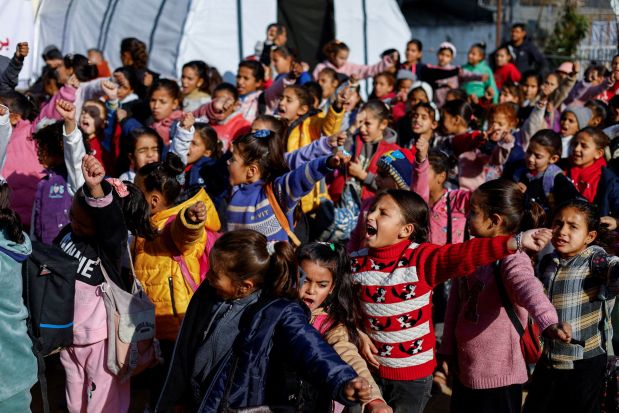
The UN children’s agency said yesterday it had for the first time in two-and-a-half years been able to deliver school kits with learning materials into Gaza after they were previously blocked by Israeli authorities.
Thousands of kits, including pencils, exercise books and wooden cubes to play with, have now entered the enclave, Unicef said.
“We have now, in the last days, got in thousands of recreational kits, hundreds of school-in-a-carton kits. We’re looking at getting 2,500 more school kits in the next week, because they’ve been approved,” Unicef spokesperson James Elder said.
A spokesperson for COGAT, the arm of the Israeli military that oversees aid flows into the Gaza Strip, confirmed it had recently allowed Unicef to bring in learning kits though not text books. A COGAT spokesperson told Reuters learning kits had been let in several times during the war, without saying how.
Children in Gaza have faced an unprecedented assault on the education system, as well as restrictions on the entry of some aid materials, including school exercise books and pencils, meaning teachers had to make do with limited resources, while children tried to study at night in tents without lights, Elder said. During the conflict some children missed out on education altogether, facing basic challenges like finding water, as well as widespread malnutrition, amid a major humanitarian crisis.
“It’s been a long two years for children and for organisations like Unicef to try and do that education without those materials. It looks like we’re finally seeing a real change,” Elder stated.
Unicef is scaling up its education to support half of children of school age – around 336,000 – with learning support. Teaching will mainly happen in tents, Elder said, due to widespread devastation of school buildings in the enclave during the war which was triggered by Hamas’ assault on Israel on October 2023.
At least 97 per cent of schools sustained some level of damage, according to the most recent satellite assessment by the UN in July.
l Israel has cleared land in southern Gaza for the construction of a camp for Palestinians potentially equipped with surveillance and facial recognition technology at its entrance, a retired Israeli general who advises the military said yesterday.
Retired reservist Brigadier-General Amir Avivi told Reuters in an interview that the camp would be built in an area of Rafah cleared of tunnels built by Hamas, with entry and exit tracked by Israeli personnel.
&uuid=(email))