

Government specialists have ruled out Bahrain’s underground aquifer as the source of water seeping beneath homes in Samaheej.
But affected residents – along with their municipal councillor – argue that technical findings alone will not resolve what has become a worsening crisis threatening both homes and livelihoods.
The problem is centred on Block 243 in Samaheej, where unexplained water has been emerging beneath residential properties. The seepage has cracked floors, weakened building foundations, and caused humidity levels inside homes to rise sharply.
Residents fear long-term structural damage, mounting repair costs and declining property values.

Mr Al Mubarak
In a formal response to the Muharraq Municipal Council, Municipalities Affairs and Agriculture Minister Wael Al Mubarak outlined the steps taken after an urgent request for intervention.
He said specialists from the Water Resources Department were dispatched to the site to inspect the complaint and assess the area from a hydrogeological standpoint.
“A water sample was collected for laboratory analysis on November 26 and 27, 2025,” the minister said, adding that the process was carried out ‘in co-ordination with the relevant parties in the Water Transport Department of the Electricity and Water Authority (EWA)’.
Following on-site inspections, sampling and mapping, the ministry reached a key conclusion.
“The team concluded that it is unlikely the water flow is the result of a leak from the underground aquifer,” Mr Al Mubarak said.
He explained that Bahrain’s freshwater aquifer lies around 40 metres below sea level, making it ‘difficult to drill to reach such depths within residential project areas’.
In addition, topographic surveys showed that the affected homes are located two to three metres above sea level and approximately 250 metres from the coastline, further distancing the problem from natural groundwater sources.
Mr Al Mubarak reaffirmed that the ministry remains in contact with the Muharraq Municipal Council and other relevant authorities, indicating that further co-ordination is ongoing.
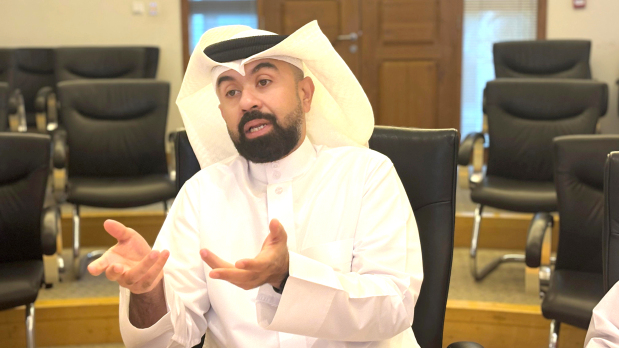
Mr Al Oud
However, Samaheej councillor Fadhel Al Oud, who also chairs the council’s financial, administrative and legislative committee, said residents are running out of patience and need solutions, not studies.
“I don’t care about the findings more than I care about actual solutions,” Mr Al Oud said. “Homes are flooded, walls are cracking and foundations are being damaged. This is no longer a technical puzzle – it’s a living crisis.”
Mr Al Oud said he was the first to raise the alarm after residents reported water seeping through floors, pooling in yards and creating what he described as an unhealthy environment, marked by persistent dampness, humidity and mold.
“Whether this is trapped groundwater, seawater intrusion or something else entirely, the impact is the same,” he said. “People’s homes are being damaged, and the government must act urgently.”
Mr Al Oud stressed that if the problem is linked to land conditions, drainage design or infrastructure planning, residents should not be left to shoulder the burden.
“They did nothing wrong,” he said. “They built legally and responsibly. If the land has failed them, the state must step in – either by fixing the problem or compensating those affected.”
For homeowners, frustration is growing as water continues to seep beneath their properties.
“We don’t want more reports. We want the water gone,” Mr Al Oud said.
mohammed@gdnmedia.bh
&uuid=(email))