

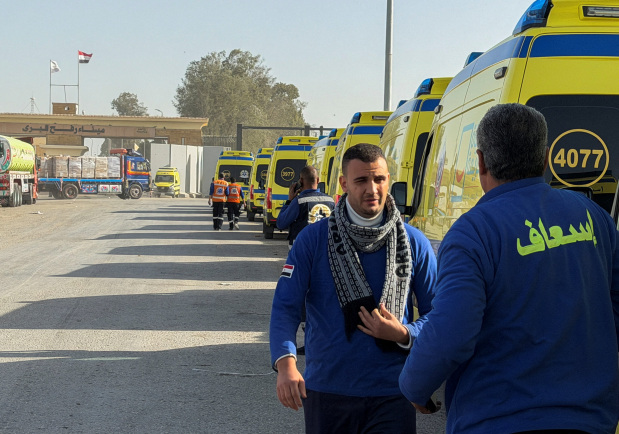
Dozens of Palestinians were expected to leave or return to Gaza after Israel yesterday reopened the sole pedestrian crossing to Egypt, a major step in the ceasefire intended to end the war, though with strict limitations on access.
The Rafah crossing, in what was once a city of a quarter of a million people that Israel has since completely demolished and depopulated, is the sole route in or out for nearly all of Gaza’s more than two million residents.
It was largely shut for most of the war, and reopening it to allow access to the outside world is one of the last significant steps required under the initial phase of a US-brokered ceasefire reached in October.
An Israeli security official said Rafah had opened around 9am ‘for both entry and exit’. A Palestinian source said that on the first day 50 Palestinians were expected to re-enter the coastal Gaza Strip.
Egyptian and Palestinian sources said the 50 Palestinians returning to Gaza were being processed at the Palestinian Israeli-controlled side of the border, but it was unclear when they would enter the enclave, pending Israeli security checks.
Five patients seeking to leave Gaza for medical treatment, each escorted by two relatives, were driven to the crossing compound from the Gaza side in a vehicle escorted by World Health Organisation personnel, health officials said.
Later, Palestinian and Egyptian sources said Gaza patients had crossed into the Egyptian side of the passage and would be directed towards Egyptian hospitals.
Palestinian officials blamed delays on Israeli security checks. Israel’s military had no immediate comment.
“The crossing is a lifeline for Gaza, it is the lifeline for us, the patients,” said Moustafa Abdel Hadi, 32, who receives kidney dialysis at Al Aqsa Martyrs Hospital in central Gaza and is one of 20,000 Gazans hoping to leave for treatment abroad.
“We want to be treated in order to return to live our normal life.”
Israel seized the border crossing in May 2024, about seven months into the Gaza war. Since then, it has largely been closed apart from a brief period during an earlier truce in early 2025.
Reopening the crossing was one of the requirements under the October ceasefire that outlined the first phase of US President Donald Trump’s plan to stop fighting between Israel and Hamas.
In January, Trump declared the start of the second phase, meant to see the sides negotiate the shattered enclave’s future governance and reconstruction.
Even as the crossing reopened, Israeli strikes killed at least four Palestinians yesterday, including a three-year-old boy, in separate incidents in the north and south of the strip.
In the war’s early months before Israel shut the crossing, some 100,000 Palestinians exited to Egypt through Rafah.
Though Egypt has repeatedly made clear it will not allow a large-scale exodus, the route is seen as vital for wounded and sick Palestinians to seek medical care. While it was closed, only a few thousand were allowed out for medical treatment in third countries through Israel.
Palestinians seeking to cross at Rafah will require Israeli security approval, three Egyptian sources said. Reinforced concrete walls, topped with barbed wire, have been installed along the crossing area, the sources said.
At the crossing they will have to pass through three separate gates including one administered by the internationally recognised Palestinian Authority under supervision of a European Union task force but controlled remotely by Israel.
l Palestinian President Mahmoud Abbas said elections will be held on November 1 for the Palestinian National Council, the parliament of the Palestine Liberation Organisation (PLO), the official news agency Wafa reported yesterday.
This is the first time members of the council will be elected by direct popular vote.
&uuid=(email))