

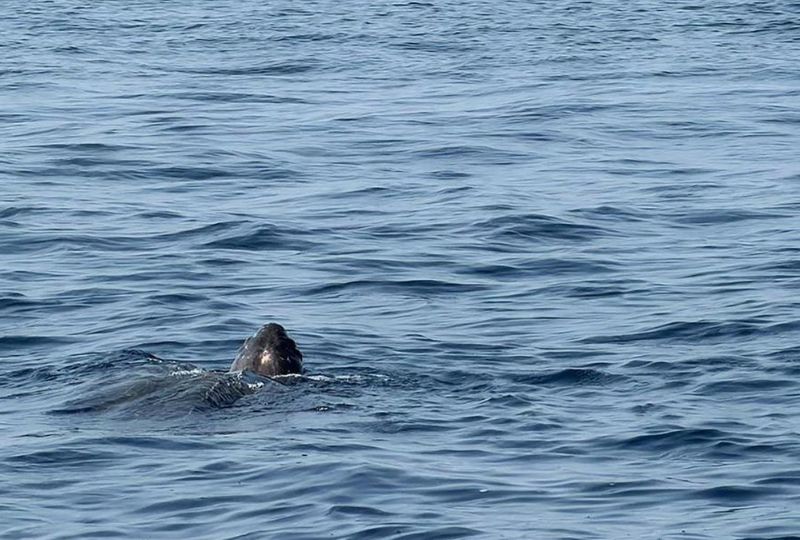
The National Centre for Wildlife recorded a rare sighting of a leatherback sea turtle in the Red Sea, one of the world’s most critically endangered marine species. The sighting occurred about 30 kilometres off the coast of Al-Qunfudhah Governorate, within the newly established Blue Holes Protected Area.
The centre said the sighting is among the very few recorded cases of the species in the Red Sea. The leatherback is the largest sea turtle in the world, weighing up to 900 kilograms. It is distinguished by its leathery black shell, five longitudinal ridges along its back, and its ability to dive to depths exceeding 1,000 meters.
It added that leatherback turtles are known for long-distance migrations spanning thousands of kilometres in search of food, particularly jellyfish. Their nearest known ranges are in the Indian Ocean between South Africa and Sri Lanka, about 7,000 to 8,000 kilometres away, and near Sri Lanka at roughly 5,000 kilometres.
Nesting sites are also found in India’s Andaman Islands, around 6,500 kilometres distant.
The centre noted that no nesting sites have been recorded in the Red Sea, suggesting the turtle likely crossed the Bab el-Mandeb Strait in search of food. Such a journey is considered exceptional for the species due to the navigational precision required.
According to the IUCN Red List, leatherback turtles are classified as Critically Endangered in the Indian Ocean, while data for the Red Sea and Arabian Gulf remain insufficient due to limited records. The most recent regional sightings include a juvenile documented in Jordan in December 2025 and another off the coast of Djibouti in December 2019.
The centre emphasised that such rare sightings may indicate a possible expansion of the species’ range into the Red Sea and underscore the importance of continued conservation efforts. It noted that the Farasan Islands Marine Protected Area and the newly designated Blue Holes and Ras Hataba reserves represent key steps toward safeguarding endangered marine life in the region.
&uuid=(email))