

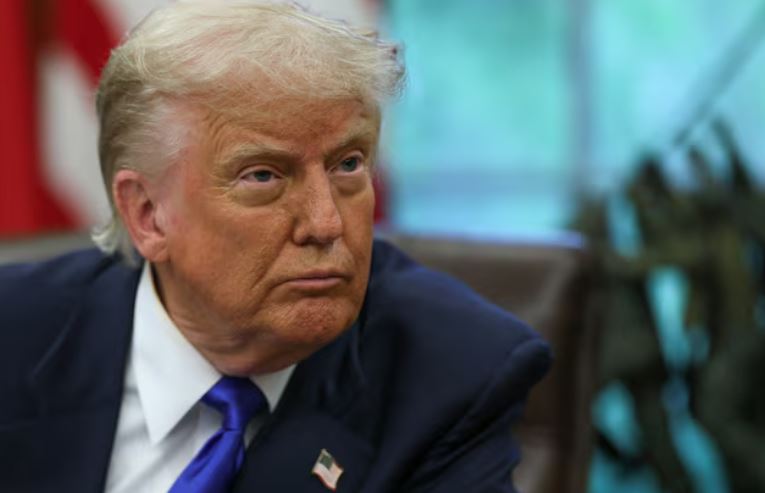
US President Donald Trump yesterday said he was considering sending a second aircraft carrier to the Middle East, even as Washington and Tehran prepare to resume negotiations aimed at averting a new conflict.
Oman facilitated talks between Iran and the US last week, which a spokesperson for Iran’s foreign ministry said had allowed Tehran to gauge Washington’s seriousness and showed enough consensus for diplomacy to continue.
The talks came after Trump had positioned one aircraft carrier in the region, raising fears of new military action. Trump, who joined an Israeli bombing campaign last year and hit Iranian nuclear sites, had threatened last month to intervene militarily during a bloody government crackdown on nationwide protests in Iran, but ultimately held off.
In interviews with Israeli media, Trump said the United States would have to do ‘something very tough’ if a deal is not reached with Iran.
“Either we reach a deal or we’ll have to do something very tough,” Israel’s Channel 12 quoted him as saying.
The date and venue of the next round of US-Iran talks have yet to be announced.
Trump told Channel 12 and Axios that he was also considering sending a second aircraft carrier to the Mideast.
The USS George Washington in Asia and the USS George H W Bush on the US east coast are the most likely candidates, officials have told Reuters, but each is at least a week away from the Middle East. The Pentagon could also deploy the Ford carrier from the Caribbean.
“After the talks, we felt there was understanding and consensus to continue the diplomatic process,” said the Iranian foreign ministry spokesman, Esmaeil Baghaei.
Baghaei said trip to Oman by Ali Larijani, an adviser to Supreme Leader Ayatollah Ali Khamenei, had been pre-planned, and that Larijani would travel next to Qatar, which has also mediated in several Middle East crises.
Oil prices eased yesterday as traders remained focused on Iran-US tensions.
A Reuters analysis of satellite images showed a recent build-up of aircraft and other military equipment across the region.
In particular, US forces in Qatar’s Al Udeid, the biggest US base in the Middle East, put missiles into truck launchers as tensions with Iran ratcheted up since January, allowing them to be moved more quickly if needed.
Oman’s state news agency said Larijani and Omani Sultan Haitham bin Tariq discussed ways to reach a ‘balanced and just’ agreement between Iran and the US, stressing the importance of returning to dialogue to bridge differences and promote regional and global peace and security.
The US is seeking to expand the scope of negotiations with Iran beyond the nuclear issue to curb Iran’s ballistic missile programme, one of the biggest in the Middle East.
Tehran says its missile arsenal has been rebuilt since last year’s 12-day bombing campaign by Israel and the US, and that its stockpile is non-negotiable.
Israeli Prime Minister Benjamin Netanyahu is expected to use a meeting with Trump in Washington today to push for any US-Iran deal to include limitations on Tehran’s missiles.
Baghaei said the US ‘must act independently of foreign pressures, especially Israeli pressures that ignore the interests of the region and even the US’.
&uuid=(email))