

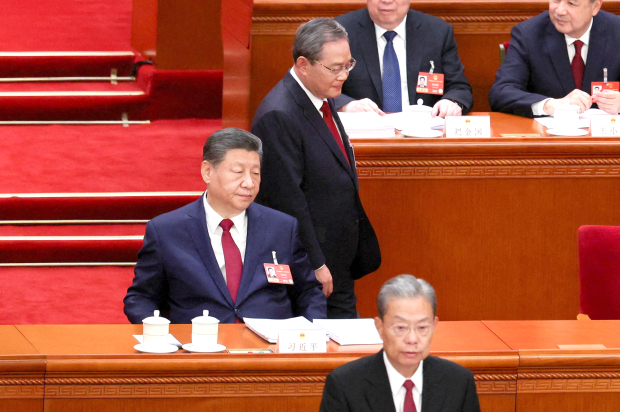
CHINA yesterday set out a five-year roadmap to turbocharge scientific breakthroughs and embed AI across its industrial economic machine, framing technological dominance as a core national security goal in its sharpening rivalry with the US.
In its 15th strategic plan since adopting Soviet-style quinquennial policy cycles in the 1950s, Beijing has outlined a bet that technology - not consumption - will drive its next phase of development despite growing structural pressures.
The objectives reflect President Xi Jinping’s vision of developing “new productive forces” to escape the middle-income trap, counter the demographic downturn, and enhance self-sufficiency to insulate China from US export controls.
At the opening of the annual parliament meeting, Premier Li Qiang praised China’s ability to withstand US President Donald Trump’s tariff hikes, but said “multilateralism and free trade are under severe threat,” announcing 7 per cent increases in the defence budget, as well as in research and development.
Li acknowledged an “acute” imbalance between strong supply and weak demand and risks from a worsening property sector crisis and high local government debt.
These challenges have pushed Beijing to set a slightly lower growth target of 4.5pc–5pc for 2026, down from last year’s 5pc, which was met largely through a one-fifth surge in its trade surplus to a record $1.2 trillion.
As widely expected, the five-year plan also pledged a “notable” increase in household consumption, without specifying figures, dampening expectations for demand-side reforms.
Last year’s trade punches with the Trump administration, which briefly escalated to embargo-like conditions of triple-digit tariffs, showed the importance of its supply chain dominance as leverage.
China vowed to maintain its competitive edge in rare earths.
The US and its allies are still years away from breaking their reliance on China for these materials vital to everything from AI chips to defence systems.
“China’s government remains laser-focused on spurring technological breakthroughs and high-tech investment,” said Fred Neumann, chief Asia economist at HSBC. “In part, this is motivated by competition with the United States for control over the technologies of the future.”
“Many international observers may be left disappointed, therefore, by slower progress in rebalancing the economy away from investment towards consumption.”
China invests 20 percentage points of GDP more than the global average, while its households spend roughly 20 points less – a state-controlled, debt-driven development model that analysts say creates industrial overcapacity and fuels trade tensions abroad and deflationary pressures at home.
&uuid=(email))