

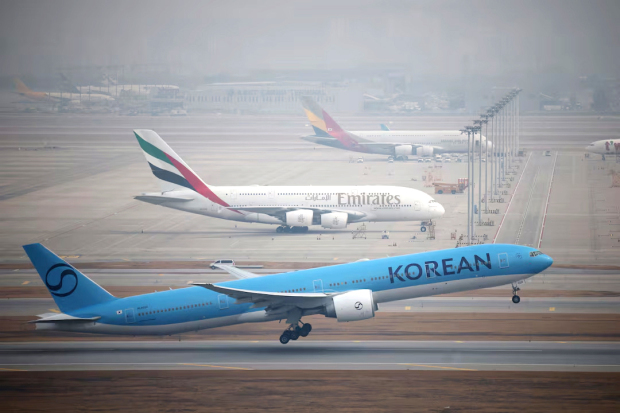
Shares of US and European airlines fell yesterday after US-Israeli strikes on Iran roiled global aviation, pushing oil prices higher, but shares of a handful of Asian carriers were boosted by a tentative resumption of some Middle East flights.
Governments have scrambled to organise flights out of the Middle East for tens of thousands of citizens stranded by the escalating conflict, which has closed most of the region’s airspace because of the risk of missile strikes.
Takeoffs from Dubai International Airport more than doubled on Wednesday, the latest data from Flightradar24 show, as activity slowly restarted at the world’s busiest travel hub, which was brought to a near standstill amid the conflict.
Traffic remained far below normal levels, with global aviation disruptions likely to take time to normalise as the conflict showed little sign of easing. Air cargo has also been hit.
“The past few days have been unprecedented,” Dubai Airports CEO Paul Griffiths said yesterday on LinkedIn in his first public remarks since the air strikes began.
Azerbaijan – part of a key flight corridor between Asia and Europe – temporarily closed part of its airspace near Iran after a drone strike in the southern Nakhchivan area near the Iranian border.
Airline stocks have been hammered since the initial strikes last weekend on fears of prolonged route closures and higher fuel costs.
Jet fuel prices have soared globally, hitting an all-time high in Singapore, S&P Global Platts said yesterday.
US airlines have limited exposure to Middle East routes, and the conflict has not forced the kind of network shutdowns affecting Gulf-based carriers. But higher fuel prices pose a risk to balance sheets.
Fuel is typically the second-largest expense for US airlines after labour, and many of them no longer hedge, leaving them more vulnerable to price spikes.
Without hedges, airlines must raise fares to offset higher costs. But tickets are often sold weeks or months ahead, so carriers must absorb sudden spikes in the near term.
Whether they can raise prices later depends on demand, and airlines have flagged strain among more price-sensitive travellers.
Also hitting airlines, the price of jet fuel can jump faster than crude when refineries go offline, shipments are disrupted, insurance costs rise or regional supplies tighten.
“We expect March to hit (US) airlines’ profitability due to the unanticipated jump in fuel prices,” said Nicolas Owens, an equity analyst at Morningstar.
Shares of Southwest Airlines, American Airlines, Delta Air Lines, United Airlines and Alaska Air Group were down between five per cent and 9pc in afternoon trade.
The broader NYSE Arca Airline index was down 6pc. In Europe, Air France KLM closed lower, while Lufthansa, British Airways-owned IAG and budget carrier Ryanair fell.
Wizz Air, which flagged a $58 million profit hit from the conflict, fell 9pc.
Chief Executive Officer Jozsef Varadi told Reuters the impact should be limited to the financial year ending this month and said the carrier was shifting capacity toward Europe.
Fitch Ratings said most European and Middle Eastern carriers maintain relatively high fuel-hedging levels, with coverage for the next three months ranging from about 50pc to more than 80pc.
Some Asian stocks rebounded. Cathay Pacific Airways, Qantas Airways and Korean Air Lines rose, while Japan Airlines edged down.
Major Chinese carriers such as Air China, China Eastern Airlines and China Southern Airlines fell between 1.5pc and 4pc in both Hong Kong and Shanghai.
Gary Ng, a senior economist at Natixis, said Asian airlines were sensitive to Iran’s situation given the impact on routes, revenue and costs.
Emirates and Etihad are now operating limited services from Dubai and Abu Dhabi through safe air corridors.
An Emirates spokesperson said more than 100 flights should depart from Dubai with passengers and cargo today.
Qatar Airways said it would run limited relief flights for stranded passengers, departing from Muscat in Oman to six European destinations including London, Berlin and Rome as well as from Riyadh to Frankfurt.
Governments from the US to Canada and across Europe have arranged charter flights and helped secure seats on commercial services to repatriate citizens. More than 17,500 Americans have returned to the US since February 28.
A flight carrying Kenyans and others fleeing the UAE arrived in Nairobi yesterday, including 13 children and their teachers who had been on a school trip to the Gulf.
“We were stuck there for five days ... it was scary, every day we would get alerts and the children would just lose it,” school director Olive Tindika told Reuters, saying the children arrived in tears at teachers’ hotel rooms whenever explosions lit up the sky.
“It was a very, very traumatising experience.”
&uuid=(email))