

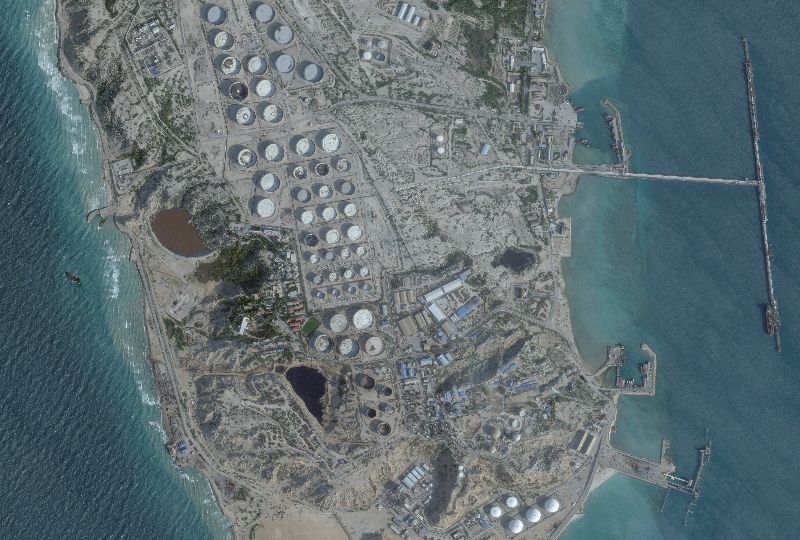
WASHINGTON/DUBAI/JERUSALEM - US President Donald Trump threatened to strike the oil infrastructure of Iran's Kharg Island hub unless Tehran stopped attacking vessels in the Strait of Hormuz, a warning that could further roil markets coping with a historic supply disruption.
Trump paired his Friday ultimatum with a social media post saying the US had "totally obliterated" military targets on the island, the export terminal for 90% of Iran's oil shipments, which lies about 300 miles (500 km) northwest of the strait.
US strikes did not target Kharg's oil infrastructure, but "should Iran, or anyone else, do anything to interfere with the Free and Safe Passage of Ships through the Strait of Hormuz, I will immediately reconsider this decision," Trump wrote.
IRAN SHOWS NO SIGN OF CAPITULATION AS STRIKES SPREAD
Iran could not defend against US attacks, the president said. "Iran’s Military, and all others involved with this Terrorist Regime, would be wise to lay down their arms, and save what’s left of their country, which isn’t much!" he posted on his Truth Social platform.
Trump told reporters on Friday the US Navy will "soon" start escorting tankers through the Strait of Hormuz, a conduit for 20% of the world's fossil energy supplies.
As the war entered its third week, Iran, however, has shown no sign of capitulating or bowing to US-Israeli military pressure. Iranian Supreme Leader Mojtaba Khamenei, who replaced his slain father, has said the strategic waterway should remain closed as a tool of pressure.
Iran's armed forces responded to the Kharg attack by saying any strike on their country's oil and energy infrastructure would lead to strikes on facilities owned by oil companies cooperating with the United States in the region, Iranian media reported.
Iran's semi-official Fars news agency reported, citing sources, that more than 15 explosions were heard on the island during the US attacks. The sources said air defences, a naval base and airport facilities were hit, but there was no damage to oil infrastructure. Iran, which ramped up oil output in the run-up to the February 28 launch of the war by Israel and the US, has continued to ship oil at a rate of 1.1 million to 1.5 million barrels per day, TankerTracker.com and Kpler data show.
Much of the oil shipped from Iran via Kharg goes to China, the top global crude importer.
Markets were watching for any sign that US strikes had damaged the island's intricate network of pipelines, terminals and storage tanks. Even minor disruptions could further tighten global supply, adding pressure to a volatile market.
Iran also claimed success in shooting down five drones over its airspace, bringing to 114 the total US and Israeli drones it has downed during the war, Iranian state TV reported on Saturday. Oil prices have swung sharply on Trump's changing comments about the likely duration of the war, which began with massive US and Israeli bombardments of Iran and quickly spread into a regional conflict with broad consequences for worldwide energy and stock markets.
MARKETS ROILED BY OIL INDUSTRY STRIKES
The US embassy in the Iraqi capital Baghdad was hit in a missile attack on Saturday, causing smoke to rise from the building, Iraqi security sources said. They did not have further details on the strike.
In other attacks across the region, Iran's Revolutionary Guards said they had carried out additional attacks on Israel with Lebanon's Hezbollah militia, Iran's Tasnim news agency reported. Some oil loading operations in the port of UAE's Fujairah, outside the Strait of Hormuz, have been suspended after a drone attack and fire on Saturday morning, Bloomberg News reported on Saturday citing people familiar with the matter.
At least 12 medical personnel were killed in an Israeli strike on a healthcare centre in the town of Borj Qalaouiya in southern Lebanon, the Lebanese state news agency reported on Saturday, citing the health ministry.
DEATH TOLL MOUNTS
Reports from Iranian media said at least 12 people were killed and several others wounded in attacks on multiple locations across Iran, including central and southeastern provinces.
In Khomein, southwest of Tehran, a projectile struck a rural home in the village of Khizab, killing six people and wounding seven others, according to the security deputy of the provincial governor quoted by Tasnim news agency. In Dubai, the management team of the ICD Brookfield Place, a business centre in the heart of the Dubai International Financial Centre, said in a message to its tenants seen by Reuters that an incident took place, without elaborating further. Earlier, Dubai's media office said debris from a successful interception struck a building in central Dubai, but no fire or injuries were recorded. It did not specify the location. After two weeks of war, 2,000 people have been killed, mostly in Iran but many in Lebanon and a growing number in the Gulf. Several million people have been displaced from their homes. US forces have suffered casualties, including the deaths of all six crew members aboard a refuelling aircraft that crashed in western Iraq.
&uuid=(email))