

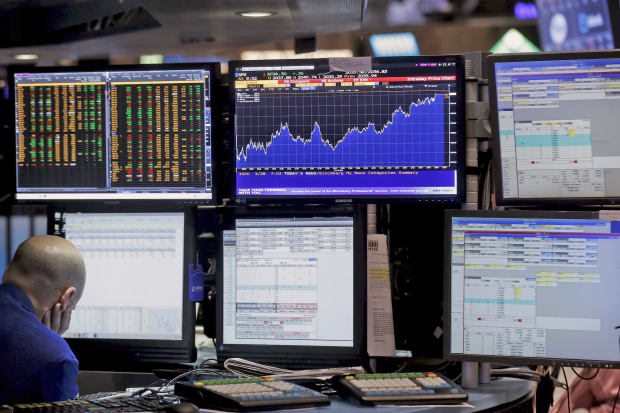
Global shares and the dollar nudged higher yesterday but were set for weekly losses while bonds remained under pressure as central banks warned that the Iran war could reignite inflation.
Trading stayed choppy and nerves frayed, highlighting how brittle investor confidence remains and how sensitive markets are to news on conflict in the Middle East.
An Axios report yesterday said that the Trump administration is considering plans to occupy or blockade Iran’s Kharg Island to pressure Iran to reopen the Strait of Hormuz.
In a choppy session Europe’s cross-regional STOXX 600 was last 0.34 per cent higher on the day, but on track for a roughly 1.7pc weekly decline, while the MSCI All-World index was set to fall for the third consecutive week.
Nasdaq futures fell 1.64pc and S&P 500 futures dipped 1.14pc, while MSCI’s broadest index of Asia-Pacific shares outside Japan fell 0.5pc yesterday but still rose a touch across the week. Following a busy week of monetary policy meetings, the key takeaway for investors has been the prospect of a more aggressive policy tightening path.
“Clearly central banks have learned that it’s very dangerous to say that an energy shock is purely transitory,” said Sandra Horsfield, economist at Investec, while also noting the risk of both direct and indirect effects.
“So hence we have a more hawkish-sounding reaction.” Traders are no longer expecting a Federal Reserve rate cut this year, while chances for a rate hike from the Bank of England and European Central Bank at their respective next meetings rose. Sources said the ECB may need to begin discussing rate increases in April and possibly tighten policy in June.
“For the time being, though, sending a more hawkish message seems a very sensible thing. But again, it’s hawkish, but it’s not immediate action,” Horsfield said.
Oil prices were also choppy yesterday, with Brent crude futures last down 1.32pc at $107.22 a barrel. Leading European nations and Japan offered to join efforts to secure safe passage for ships through the Strait of Hormuz and the US outlined moves to boost oil supply.
Natural gas prices have also soared, with those in Europe skyrocketing as much as 35pc on Thursday, as Iranian and Israeli strikes hit some of the Middle East’s most important gas infrastructure. That prompted US President Donald Trump to tell Israel not to repeat its attacks on Iranian natural gas infrastructure.
“Even if the US leaves (the conflict), Israel might not leave, and there may still be some strikes and Iran will retaliate, maybe at a lower volume,” said Alicia Garcia-Herrero, chief Asia-Pacific economist at Natixis.
“But this means that the Gulf will still be under pressure... so oil prices will not go back to $60, they will maybe stay at $90, at least until the end of the year. So the shock is already unavoidable.”
The dollar was set for a weekly loss of 1.15pc and was last a touch higher as the Fed is now seen as the only major central bank that is not expected to raise rates this year. That kept the euro holding onto most of Thursday’s 1.2pc gains to fetch $1.1575, while sterling dipped 0.22pc to $1.34, after a 1.3pc rise the previous day.
The yen, which was on the cusp of 160 per dollar in the previous session, last stood at 158.57. The Japanese currency was also helped by some hawkish comments from Bank of Japan Governor Kazuo Ueda on Thursday, after the central bank held rates steady but maintained its bias for tighter monetary policy.
In precious metals, spot gold was up close to 0.8pc at around $4,684 an ounce.
&uuid=(email))