

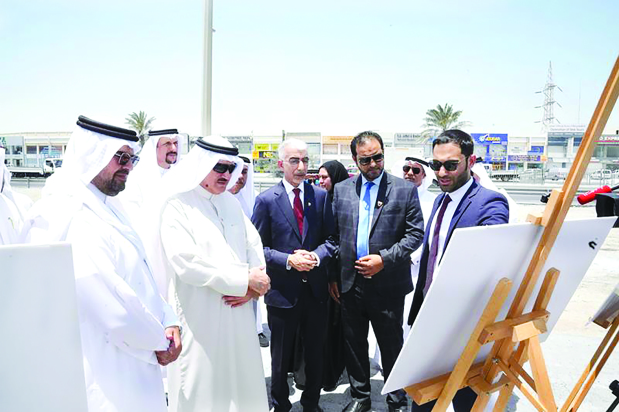
The framework agreement for a major transport corridor development was approved yesterday by His Majesty King Hamad.
The King ratified and issued a law, approving the agreement on contributing to the financing of the Shaikh Jaber Al Ahmad Al Sabah Highway Development Project (Phase II) between the Bahrain government and Kuwait Fund for Arab Economic Development.
It was earlier given the go-ahead by the Shura Council and Parliament.
The law ratifies the framework agreement which covers the terms, scope, and mechanisms of funding for the project as agreed by both parties.
The Prime Minister and the ministers, each within their capacity, shall implement the provisions of this law, which will come into force following its publication in the Official Gazette, said an official statement yesterday.
The GDN previously reported that the highway upgrade, valued at BD128.6 million, is one of Bahrain’s most important infrastructure projects aimed at strengthening economic growth and improving traffic flow between major industrial and residential areas.
It will streamline the movement of vehicles along one of the kingdom’s most important corridors linking Manama with Sitra, Ma’ameer, Eker and the Nuwaidrat industrial area.
The highway also connects to key economic sites including Bapco Refining and Alba, as well as several large industrial and commercial zones.
The project aims to expand the highway from three to four lanes in each direction over an 11km stretch between Um Al Hassam and the Nuwaidrat junction. It will also include the construction of five flyovers, new service roads on both sides of the main carriageway and upgraded infrastructure such as stormwater drainage, lighting and road markings.
In addition, Shaikh Salman Al Fateh Avenue, which branches off from Shaikh Jaber Al Ahmad Al Sabah Highway, will be expanded to four lanes along a 2km stretch.
The Kuwait Fund will provide up to 70m Kuwaiti dinars (around BD85.9m) through seven separate annual loans, each valued at 10m Kuwaiti dinars. This will cover about 66 per cent of the project’s total cost, while the remaining BD42.7m will be funded through Bahrain’s state budget.
&uuid=(email))