

China's economy picked up speed early in 2026, riding an export surge before the Iran war sent energy costs soaring and put global demand – vital to Beijing’s growth ambitions – at risk.
The 5.0 per cent year-on-year pace in the first quarter sits at the top of China’s full-year target range of 4.5pc-5.0pc, highlighting a resilience that sets it apart from much of Asia, helped by ample strategic oil reserves and a diversified energy mix.
Yet the Middle East conflict lays bare a core vulnerability: an export-led growth model that delivers annual trade surpluses the size of the Dutch economy depends on open sea lanes – for China and for the customers it sells to.
And as the world’s biggest energy importer and manufacturing powerhouse, soaring oil prices threaten to drive up production costs and squeeze already thin margins at factories that employ hundreds of millions of people. The longer the conflict drags on, the higher the risks and the pressure is already mounting.
Peng Xin, general manager of Guangdong Rongsu New Materials, which buys petrochemical feedstock from refineries and turns it into plastic pellets for injection-moulding factories, says prices for two types of nylon spiked roughly 40pc-60pc.
Peng is passing the increases on, while some of his customers rush to place orders and stockpile before costs climb further.
“The current coping method is to negotiate the price for every single order. If you accept my price, we cooperate. Otherwise, there’s nothing we can do,” he said.
“The entire industry chain is under pressure.”
The first-quarter GDP growth beat forecasts of 4.8pc and October-December’s three-year low of 4.5pc, which a statistics bureau official described as a “rare and commendable” achievement, while warning of a “complex and volatile” external environment.
But the trade data for March earlier this week pointed to strains. Exports grew just 2.5pc last month, slowing sharply from 21.8pc in January–February.
And while factory-gate prices rose out of deflation in March for the first time in more than three years, analysts warn “bad inflation” driven by input costs could be even worse for growth.
“The solid start to the year on the back of strong export performance suggests the direct impact of the Middle East conflict remains contained for now,” said Junyu Tan, North Asia economist at Coface.
“But the outlook is not all rosy despite China’s relative resilience,” Tan added. “The export engine could still be constrained by weaker global demand if the conflict persists.”
And the economy remains imbalanced, with consumers unlikely to pick up the slack if exports falter.
Retail sales, a gauge of consumption, grew 1.7pc last month, down from 2.8pc in January-February, and – as has been the norm in recent years – underperformed industrial output, which rose 5.7pc in March versus 6.3pc in the first two months.
Lending data earlier this week also showed sluggish credit demand from households and businesses.
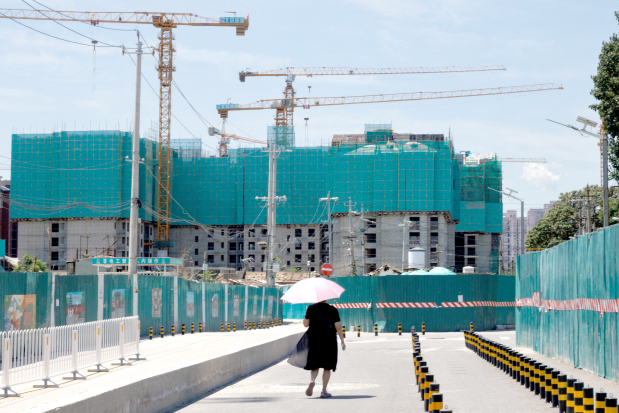
Breaking China’s protracted property slump will be critical to reviving consumption, but fresh data showing new home prices still falling suggest further pain for the country’s embattled developers.
“On one hand you see resilience – the Iran war’s impact on China is very limited. On the other hand you see imbalance - a strong export sector versus modest domestic demand,” said Tianchen Xu, senior economist at the Economist Intelligence Unit.
Analysts don’t expect the central bank to ease policy significantly, but say Beijing could deploy more fiscal firepower if the target comes under threat, adding to a debt burden more than three times the size of the economy.
Fiscal expenditure rose 3.6pc in January-February, picking up from a 1pc increase in 2025.
&uuid=(email))