

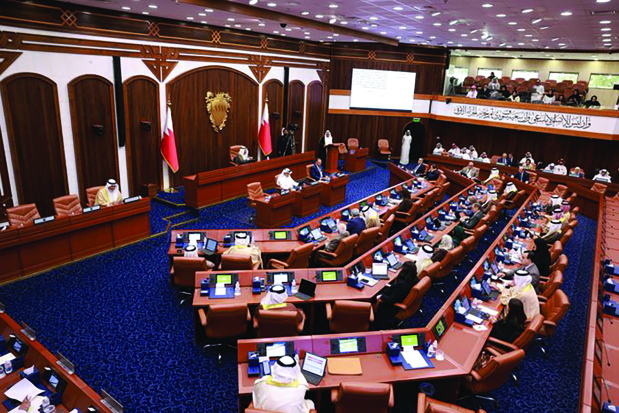
Legislators have called for stronger safeguards for national industries, urging the government to prioritise Bahraini products in the procurement of goods, construction projects and services.
A proposal to overhaul Bahrain’s industrial protection law, linking government spending directly to locally made products, has been unanimously referred to a Shura Council committee for further review.
The draft amendment, spearheaded by services committee vice-chairman Talal Al Mannai and backed by four other members, seeks to modernise Decree‑Law No (11) of 1985 concerning the Protection and Support of National Industries by embedding two new tools into public procurement – a mandatory list of national products and a minimum local content requirement in government tenders.
“This proposal is about transforming government procurement from a spending tool into a development engine,” Mr Al Mannai told the chamber. “When the state buys, it must buy in a way that strengthens Bahraini industry, creates jobs and builds resilient supply chains.”
Under the draft law, a committee formed by the Prime Minister would be tasked with protecting national industries, while the Cabinet would be empowered to issue a regularly updated list of Bahraini products that government entities must prioritise when procuring goods and services.
The amendment also introduces, for the first time, a formal definition of ‘local content – covering Bahraini manpower, goods, services and assets – and allows authorities to set a minimum percentage that bidders must include in their technical offers.
“This is not about closing the market or restricting competition,” Mr Al Mannai said. “Public tenders remain open and competitive, but we are adding a developmental dimension so that public money generates the highest economic return inside Bahrain.”
The five members behind the proposal argued that the change comes at a time when global supply chain disruptions have highlighted the need for stronger domestic production capacity and economic resilience.
The explanatory memorandum also says the legislation aligns with Article 10 of the Constitution, which calls for economic development through fair co-operation between the public and private sectors, and aims to reduce reliance on foreign sources while stimulating local industry.
It also draws on regional experience, notably Saudi Arabia, where linking procurement to local content through a dedicated authority has led to measurable industrial growth. According to the memorandum, factories included in mandatory procurement lists in Saudi achieved annual growth of around eight per cent, compared to 5pc for others.
Mr Al Mannai said Bahrain could achieve similar results by institutionalising demand for local products.
“Industrial growth does not happen by chance,” he said. “It happens when there is stable demand, legislative clarity and investor confidence. This law provides all three.”
The proposal also updates outdated terminology in the 1985 law, replacing references to the ‘Minister of Development and Industry’ with the more flexible term ‘Minister concerned with industrial affairs’, ensuring the legislation remains valid despite changes in government structure. References to the ‘State of Bahrain’ would also be replaced with ‘Kingdom of Bahrain’.
Advocates say the measure would stimulate small and medium enterprises, deepen supply chains, create quality jobs for citizens and encourage industrial investment by guaranteeing market opportunities linked to government demand.
“This is about recycling government spending within the national economy,” Mr Al Mannai added. “Every dinar spent locally creates multiplier effects in employment, innovation and investment.”
The draft will now be examined by the services committee before returning to the chamber for debate in an upcoming session.
&uuid=(email))