

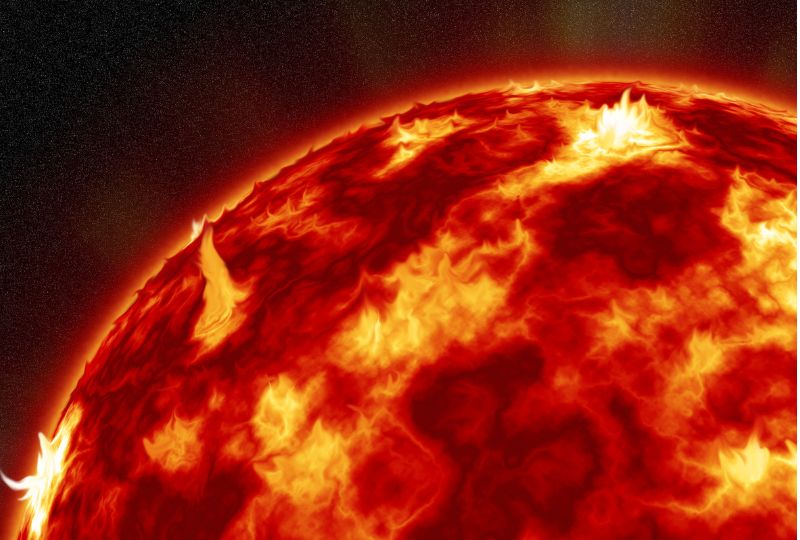
In 1859, the world experienced what many scientists consider the largest solar storm ever recorded, the Carrington Event, after the British astronomer Richard Carrington.
At that time, people did not have satellites, GPS systems, or even modern power grids. However, the storm still caused major problems on Earth. Its strength was so unusual that researchers later compared it with other solar storms and found it far beyond anything most people had seen before.
The Carrington Event began far away from Earth and the Sun. The sun occasionally releases bursts of charged particles and energy. Most of the time, these effects are small and harmless. However, in 1859, the sun produced an extremely intense disturbance. When high-energy particles reach Earth, they interact with the planet’s magnetic field. This triggered a dramatic chain reaction in the planet’s upper atmosphere. The result was a massive geomagnetic disturbance, which made the magnetic environment around Earth unusually active and powerful.
One reason the Carrington Event became well-known is that it affected a technology that was already changing daily life in the mid-1800s: the telegraph. The telegraph system relied on electrical currents that moved through long wires.
During the storm, these wires acted as unintended receivers of the energy flowing through the earth. As a result, the telegraph operators reported strange behaviour. Messages were delayed or distorted, and in some cases, the system appeared to shut down or spark. In other words, the storm disrupted communication at a time when there was no easy-to-use backup system. This made the disruption even more serious.
Another striking feature of the Carrington Event was the light show it created. When the incoming particles collide with gases in the Earth’s atmosphere, they can cause colourful auroras, also known as Northern Lights and Southern Lights. During the Carrington Event, these lights were observed much farther from the poles than usual. People watched bright curtains of colour in places that rarely experienced auroras. The beauty of the sky made the storm memorable, but the underlying cause – dangerous space weather – was a real concern for scientists and historians.
Today, researchers study the Carrington Event for modern reasons. Today, we depend on technology that did not exist in 1859. For example, modern electricity grids can be damaged by geomagnetic disturbances (GMDs). Satellites can also be damaged, affecting weather forecasting and global communications. Navigation systems, such as GPS, rely on stable conditions in space and on Earth. Airline operations can also depend on satellite data. Therefore, while the telegraph was the key victim in 1859, many modern systems could be at risk if a storm of the Carrington Event’s strength occurred again.
This is where the idea of an ‘Internet apocalypse’ comes from. Some experts warn that an extremely powerful solar storm could affect electronics and networking equipment in complicated ways. Space and weather conditions can generate strong atmospheric currents and currents in parts of Earth’s electrical systems. If these currents disrupt power supplies or damage components, the effect can spread.
In the modern world, this could mean slowdowns, outages, and communication failures. It would not be on the scale of the chaos of 1859, but it could still be serious because the internet and related systems depend on electricity, data centres, and continuous connectivity.
The website Space.com has discussed these risks and suggested that such an event could be extremely dangerous for modern life. It notes, “It’s been conjectured today, could cause an Internet apocalypse.” This statement reflects a common concern among scientists: even if the Internet itself is not directly “in the sky”, the infrastructure that powers it is deeply connected to electricity and computer networks.
Geomagnetic storms can interrupt power, disrupt hardware, and interfere with satellite communications. This could lead to widespread failures across networks that people use daily.
However, it is also important to recognise that scientists are still learning how solar storms affect different technologies. Some effects are easier to predict. For example, the strength of a magnetic disturbance can be estimated by studying physical evidence and historical records.
Researchers have also compared the Carrington Event to other past storms. However, how a storm would interact with today’s grid designs, satellite orbits, and safety protections is difficult to determine with absolute certainty.
Nevertheless, the Carrington Event remains a critical warning. This demonstrates that nature can deliver extreme energy in ways that challenge human systems. The biggest solar storms may be rare, but history shows they do happen. When they do, the consequences can reach far beyond the sun itself.
The telegraph lines that were disrupted in 1859 were only the beginning of the problem. The modern world, with its heavy reliance on electricity, satellites, and high-speed data, is far more complex and interconnected than it was in the nineteenth century.
In the end, the Carrington Event is not just a story about old auroras and damaged telegraph equipment. This is a reminder that space weather is important. The sun can still produce storms powerful enough to unsettle the Earth’s magnetic environment and disrupt communications. Although scientists cannot predict exactly when the next extreme storm will arrive, they can use past data to prepare for the future. Such preparation may be the difference between a manageable outage and a crisis that feels unimaginable.
Dr Aloma Jayasundera
&uuid=(email))