

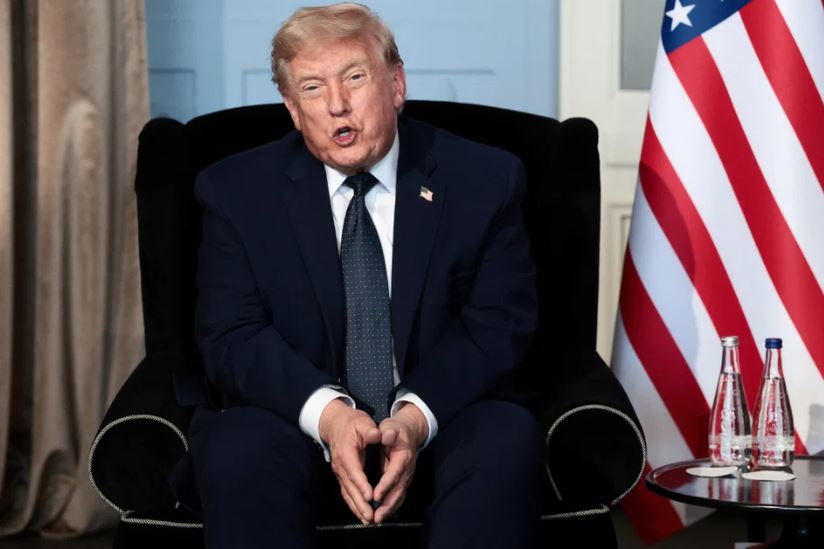
US President Donald Trump said yesterday a preliminary agreement to end the war in the Middle East has already been signed by the United States and Iran, though details have yet to be made public.
“The deal’s all signed,” Trump said after he arrived in France for a summit of the G7 group of big economies, adding that Vice President JD Vance would attend a formal signing ceremony in Geneva on Friday.
The agreement would reopen the blockaded Strait of Hormuz and extend a ceasefire for 60 days, allowing negotiators to tackle difficult issues like the future of Iran’s nuclear programme. Oil prices fell to their lowest level since March 10, shortly after the conflict cut off one-fifth of the world’s oil supply.
The deal is the most significant step yet to resolve the conflict, which has killed at least 7,000 people, mostly in Iran and Lebanon, and upended global energy markets. But much about the agreement remains unknown.
US and Iranian officials say it could eventually deliver substantial economic benefits to Iran by lifting sanctions, unfreezing foreign assets and setting up a $300 billion reconstruction fund.
US officials, speaking on condition of anonymity, said Iran would have to satisfy US demands never to build a nuclear weapon and cut off support for proxy militias like Hizbollah in order to get those benefits.
Details will be released sometime over the next two days, US officials said.
Trump appears to have achieved little of what he set out to do when he launched strikes on Iran with Israel on February 28. Iran’s theocratic government remains in place, while his demands that Tehran dismantle its ballistic missile programme and end support for regional militias remain unmet.
It also does not resolve the fate of Iran’s uranium stockpile. Iranian officials, who have always denied intending to build a nuclear weapon, say they have given up little.
While the deal lifts Iran’s chokehold on the Strait of Hormuz, that only restores the prewar status quo and shippers say navigation will only restart once safety is assured.
Iran has suggested it will retain control with Oman over the strait. The United States says the strait will be open toll-free for 60 days and said it would expect that provision to be part of a final agreement as well.
The parallel war between Israel and Hizbollah in Lebanon, which has uprooted 1.2 million people, also remains a sticking point.
Iran has said the deal requires a full cessation of hostilities there, but Israeli Prime Minister Benjamin Netanyahu said that Israel would keep its forces in southern Lebanon and would retain the right to respond to Hizbollah attacks. “Iran wanted us to withdraw from it, but I stood firm,” he said at a news conference, where he acknowledged that he and Trump have had their differences over the conflict.
A US official said Israeli withdrawal from Lebanon was not a condition of the deal.
US Vice President JD Vance said that no funds would be released to Iran in exchange for signing the agreement to halt the war and open the Strait of Hormuz and that text of the framework deal would be shared this week.
In an interview on ABC’s Good Morning America programme, Vance said signing the memorandum of understanding with Iran would not trigger the release of frozen assets.
Vance said the agreement was already signed digitally on Sunday and no funds were released.
“There’s been no money released, and that won’t change,” he said.
&uuid=(email))