

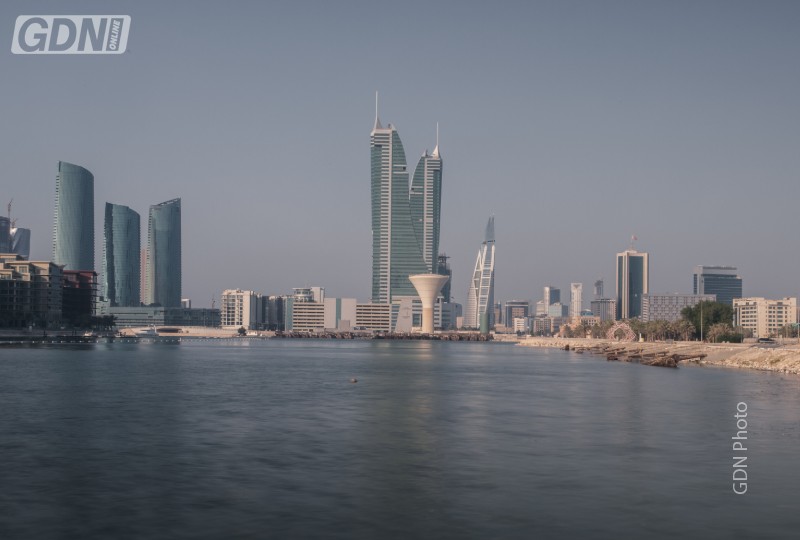
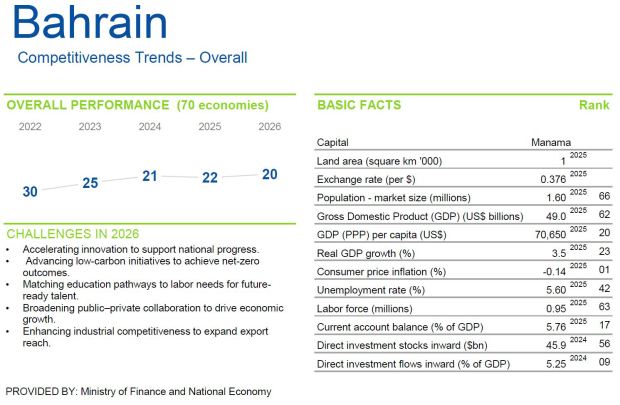
Bahrain has broken into the world’s top 20 economies, marking a historic achievement in the newly released 2026 IMD World Competitiveness Ranking.
The milestone caps off a remarkable multi-year climb for the kingdom, which has steadily marched up the global rankings from 30th place in 2022 to an elite 20th position today.
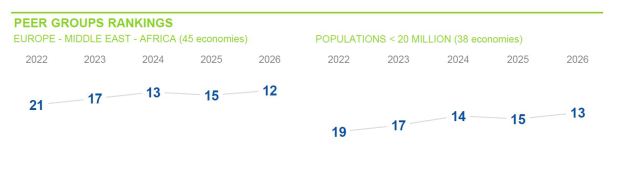
This steady ascent is mirrored across regional and demographic peer groups. In the highly competitive Europe-Middle East-Africa pool, Bahrain surged to 12th place out of 45 economies — a massive jump from its 21st-place standing in 2022.
Similarly, among nations with populations under 20 million, the kingdom moved from 19th in 2022 to an impressive 13th out of 38 countries this year.
The underlying data shows that Bahrain is punching well above its weight across the index’s core pillars.
In the Economic Performance category, the country secured an extraordinary third place globally for Prices and 11th for International Trade.
Government Efficiency metrics also reveal a highly agile business climate, with Bahrain ranking fifth worldwide in Tax Policy and 11th in Business Legislation, though public finance remains an area of ongoing consolidation at 67th.
Meanwhile, corporate and market environments are thriving under Business Efficiency, where the kingdom clinched seventh place for its Workplace Attitudes and Values, 11th for its Labour Market, and 12th for Management Practices.
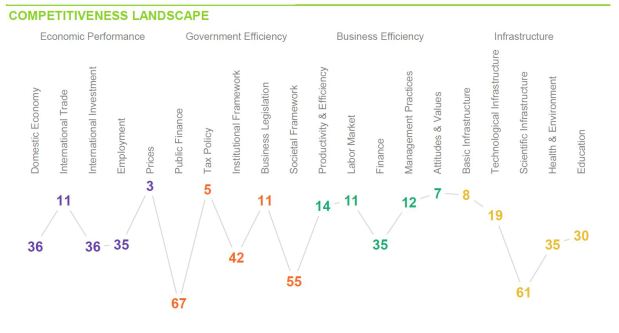
On the infrastructure front, aggressive digital and logistical investments paid off with an eighth-place finish in Basic Infrastructure and 19th in Technological Infrastructure, while scientific infrastructure highlights an area for future development at 61st.
This competitive edge is backed by rock-solid macroeconomic fundamentals. The kingdom’s GDP stands strong at $49 billion, powered by a steady real growth rate of 3.5 per cent.
On an individual level, Bahrainis enjoy substantial purchasing power, with a massive GDP (PPP) per capita of $70,650 that ranks 20th globally.
This vibrant economic backdrop continues to act as a magnet for foreign enterprise, pushing inward direct investment flows to a stellar 5.25pc of GDP — placing Bahrain ninth in the world for drawing foreign investment.
Looking ahead, the Finance and National Economy Ministry is keeping its foot on the gas with five clear strategy targets to sustain this momentum.
The kingdom is prioritising innovation acceleration by backing technological breakthrough initiatives, alongside aggressive low-carbon transitions to hit national net-zero sustainability goals. There is also a major push for educational alignment to ensure academic and vocational pathways directly feed the labour market with future-ready talent.
Finally, the roadmap calls for deeper public-private synergies to catalyse non-oil economic growth, and enhanced industrial competitiveness to expand the reach of Bahraini exports globally.
Overall, the IMD report notes that credible institutions and the rule of law are overtaking traditional factors like cost and scale as the primary engines of economic competitiveness amid worsening global fragmentation.
The index of 70 economies reveals a shifting landscape where government efficiency, institutional predictability, and currency strength dictate resilience.
“Nations with tried and tested, credible institutions gain an advantage because businesses can carry on as usual,” said IMD World Competitiveness Centre director Arturo Bris.
Singapore recaptured the top spot, rebounding on surging business efficiency and robust GDP growth, though executives flagged business relocation as a primary threat. Hong Kong SAR climbed to second, driven by regulatory agility and private sector investment.
Switzerland fell to third as a severe slump in direct investment flows hammered its economic performance, exposing it to geopolitical shocks.
The report, combining hard data with a survey of 6,900 executives, shows corporate confidence fracturing along regional lines. A sentiment rebound returned the US to the top 10, while Chinese executives cited weak domestic demand. Vietnam, Namibia, Kenya, and Oman entered the ranking for the first time.
avinash@gdnmedia.bh
&uuid=(email))