

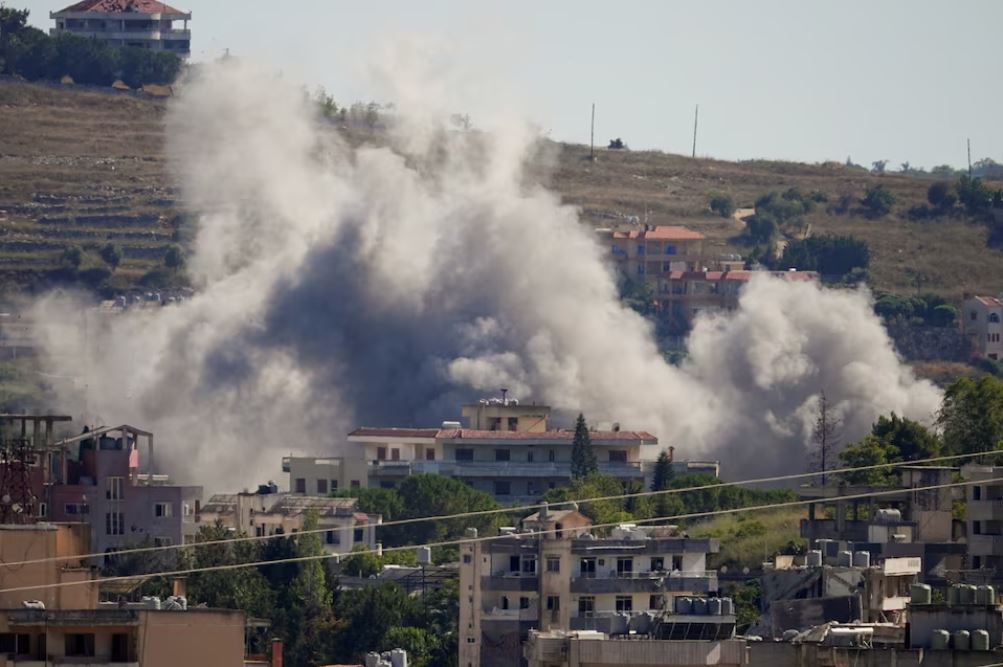
Israel and Hizbollah agreed to a ceasefire in Lebanon yesterday after an escalation in fighting there jeopardised the chances of an interim agreement on ending the war in Iran turning into a lasting Middle East peace deal.
US-Iran talks in Switzerland planned for yesterday were cancelled as fighting flared in Lebanon, creating new uncertainty about the timing of negotiations vital to ensure the reopening of the Strait of Hormuz to global shipping.
US President Donald Trump later told NBC News that he had spoken with Israel and asked it to agree to the ceasefire.
“You just gotta calm down sometimes and use your head,” Trump was quoted as saying by an NBC reporter on X, who added that the president had declined to specify whether he spoke with Israeli Prime Minister Benjamin Netanyahu directly.
A senior US official said the ceasefire came into effect around 4pm Lebanon time following an exchange of fire, adding that negotiators for the US and Qataris had worked out the agreement with help from Iran.
Two sources from Iran-aligned Hizbollah and a senior Israeli official confirmed the ceasefire to Reuters.
“If Hizbollah does not attack us, then for us it is not a time of war,” the Israeli official said, adding that Israel would keep its forces in southern Lebanon, where it has occupied an area along Israel’s northern border.
Two Lebanese security sources said Israel had carried out a dozen air strikes in the first hour of the ceasefire but none were recorded after 5pm.
The conflict in Lebanon could weigh on negotiations because ending fighting there is a condition for the broader US-Iran accord.
The memorandum of understanding signed this week by the Iranian and US presidents left discussion of Iran’s nuclear programme and other tough issues until later, giving the sides 60 days to reach a lasting agreement or extend the interim deal.
Preparations for technical talks to start in the Swiss mountaintop resort of Buergenstock were far advanced when a White House spokesperson said that US Vice President JD Vance had dropped plans to attend.
A Swiss foreign ministry statement said the talks had been postponed and that Switzerland remained ready to facilitate the talks and the relevant preparatory work was continuing.
Hizbollah’s Hassan Fadlallah cited Iran as saying further talks depended on a comprehensive ceasefire being in place and said Lebanon’s government should reject direct negotiations with Israel as long as Israeli attacks continue.
The broad interim deal requires the United States, Iran and their allies to declare an immediate and permanent termination of military operations on all fronts, including in Lebanon.
Israel, left out of the talks, says it is not party to the deal.
Iran’s Foreign Minister Abbas Araqchi, in a phone call with his Pakistani counterpart yesterday, said the US would be responsible for any violation of its commitments under the deal, including ending the fighting in Lebanon, his ministry said.
Lebanon’s health ministry said 18 people had been killed and 33 wounded in heavy air strikes in 11 southern towns since midnight till yesterday.
The Israeli military said four soldiers had been killed in an incident in Lebanon, without giving further details.
It said it had carried out strikes targeting what it described as Hizbollah operatives and infrastructure across several areas of the south, saying these were in response to repeated ceasefire violations by the Iran-backed group.
Lebanese President Joseph Aoun condemned the Israeli attacks but said the escalation would not hinder efforts to reach a comprehensive ceasefire.
The Iran war, which began on February 28 with US and Israeli air attacks on Iran, has killed at least 7,000 people, mostly in Iran and Lebanon.
It also pushed up energy prices, stoking inflation worldwide.
The body set up by Iran to manage the strait said yesterday it would waive planned fees to use the waterway during the 60-day negotiation period under the interim deal.
The memorandum signed this week foresees relief for Iran from economic sanctions, the unfreezing of assets worth tens of billions of dollars and immediate US waivers for its exports of oil.
&uuid=(email))