

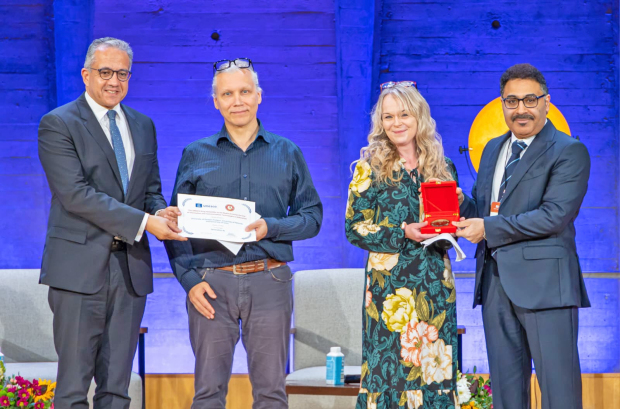
Winners of the Unesco King Hamad Bin Isa Al Khalifa Prize for the Use of Information and Communication Technologies (ICTs) in Education were honoured at a ceremony held at the Unesco headquarters in Paris yesterday.
Held under the patronage of His Majesty King Hamad, the ceremony was attended by Education Minister Dr Mohammed Mubarak Juma, Unesco Director-General Dr Khaled El Enany, senior Unesco officials, representatives of education ministries from around the world, members of the diplomatic corps, media representatives, heads of national commissions for education, science and culture, researchers and specialists, as well as Bahraini students studying at French universities.
Dr Juma and Dr El Enany presented the award to the two winning projects for 2026: Generation AI, submitted by universities in Finland, led by the University of Eastern Finland, the University of Helsinki and the University of Oulu, together with a number of partners; and Redação Paraná, an AI-powered educational platform submitted by the Paraná State Department of Education in Brazil.
During his address, Dr Juma conveyed the greetings of His Majesty and His Royal Highness Prince Salman bin Hamad Al Khalifa, Crown Prince and Prime Minister, and their congratulations to the winners. He also conveyed the leaders’ appreciation for the longstanding partnership with Unesco.
The Education Minister congratulated the winners and expressed appreciation to the jury for its efforts in evaluating the nominations and selecting the winning projects.
Dr Juma noted that the award coincides with the King’s order designating this year as the ‘Year of Isa Al Kabeer’, in honour of Isa Al Kabeer, the builder of the modern state and leader of Bahrain’s institutional development, during whose reign education transitioned from traditional forms of education to modern formal education.
He said that the Education Ministry will soon launch its artificial intelligence-powered educational platform, providing more than 100 educational and administrative services to students, teachers and parents.
Dr Juma pointed out that Bahrain began implementing the International Baccalaureate (IB) programme in government schools at the start of the current academic year, becoming the first country in the region to integrate the IB curriculum directly into the government education system.
The ceremony featured a film produced by the ministry on education in Bahrain and the Unesco King Hamad Bin Isa Al Khalifa Prize for the Use of ICTs in Education, as well as performances of Bahraini traditional music by a student orchestra from Bahrain.
Unesco Assistant Director-General for Education Professor Chieon Chen highlighted the importance of aligning objectives, efforts and strategies and strengthening co-ordination between Unesco and its member states to achieve the best outcomes in digital education.
He commended the two winning projects and highlighted their significance to education.
The 2026 edition of the prize was held under the theme ‘Reimagining Creativity and Critical Thinking with Artificial Intelligence’.
The two winning projects were selected from 114 nominations submitted by 58 Unesco member states and organisations.
An independent international jury comprising experts in digital technology in education selected the two projects for their outstanding use of digital technologies.
&uuid=(email))