

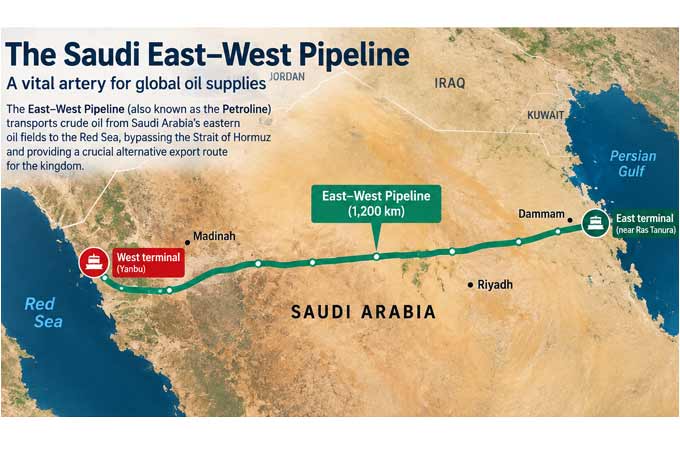
Global oil markets face a fresh supply shock after Saudi Arabia shut down its 1,200-km East-West Pipeline following multiple drone attacks, as continuing attacks on shipping in the Strait of Hormuz and a widening Houthi offensive in the Red Sea threaten to disrupt vital energy routes on both sides of the Arabian Peninsula.
The Saudi Energy Ministry said the pipeline, which runs through the Riyadh and Madinah regions, was attacked several times on Thursday and was shut down as a precautionary measure. The attacks caused injuries, while emergency and specialised technical teams were deployed to secure the facility and assess its condition.
The shutdown has heightened concern over the availability of an alternative route for Saudi crude at a time when tanker traffic through the Strait of Hormuz has already fallen sharply during the six-month war between the US and Iran.
The East-West Pipeline has in recent months been carrying an estimated 4 million to 5 million barrels of crude a day, according to ship-tracking companies and analysts. That represents roughly 4% to 5% of global oil supply.
Any prolonged interruption could therefore put further upward pressure on crude prices, which have already surged back above $100 a barrel as the conflict disrupts oil shipments through the Gulf and Red Sea.
The immediate question for the market is how much of the pipeline system has been damaged and how quickly Saudi Arabia can restore flows.
An early US assessment indicated that pumping stations located alongside the pipeline were hit. Satellite imagery reviewed after the attacks appeared to show extensive fire damage at one pumping station, while imagery from another showed a fire producing thick black smoke.
The Saudi authorities have not indicated how long the shutdown will last.
Saudi Arabia's Foreign Ministry confirmed that several drones had attacked the East-West Pipeline in the Riyadh and Madinah regions, causing injuries and damage that was being addressed.
Both Riyadh and Baghdad said the drones originated in Iraq, where Iranian-backed militias operate. Iraq has since dismissed a military commander in response to the attack, while its security forces launched an operation to identify those responsible.
The attack is particularly significant because the East-West Pipeline provides Saudi Arabia with a means of bypassing the Strait of Hormuz, the world's most important oil chokepoint.
That alternative has become increasingly important as the war between the United States and Iran has sharply reduced shipping through the strait. A sustained closure of the pipeline would leave Saudi Arabia more exposed to disruption at Hormuz just as vessels attempting to navigate the waterway continue to face attacks.
Fresh concerns emerged on Sunday after the British navy-affiliated UK Maritime Trade Operations agency said it had received a report of a projectile striking a vessel in the Strait of Hormuz.
The extent of the damage and the condition of the crew were not immediately known.
Iran-aligned Houthi forces in Yemen have been rapidly expanding their control along the country's Red Sea coast. Four Yemeni government sources told Reuters that the Houthis seized the strategic island of Perim at the entrance to the Bab el-Mandeb Strait on Friday.
The island occupies a critical position at the southern gateway to the Red Sea, through which ships travelling between the Indian Ocean and the Suez Canal must pass.
The Houthi advance has reportedly extended their control over a substantial stretch of Yemen's strategically important Red Sea coastline. Reuters has also reported that the latest Houthi offensive was carried out with direct guidance from Iran's Revolutionary Guards.
Two Iranian sources told Reuters that Tehran had instructed the Houthis to escalate attacks on Saudi Arabia and had promised additional funding, weapons and senior officers to assist the campaign.
The simultaneous pressure on the Strait of Hormuz and Bab el-Mandeb raises the prospect of an unprecedented squeeze on energy transportation around the Arabian Peninsula.
Hormuz is the principal maritime outlet for oil from the Gulf, while Bab el-Mandeb provides the gateway between the Red Sea and the Gulf of Aden. The Saudi East-West Pipeline has historically provided a critical alternative by moving crude directly towards the Red Sea.
With that pipeline now shut and both maritime routes facing attacks, the ability of Gulf producers to maintain exports is coming under increasing scrutiny.
The International Energy Agency said on Friday that Saudi crude supply had fallen to its lowest level in more than three decades, partly as a result of attacks on ships transiting Bab el-Mandeb by Houthi-linked groups.
That comes as diplomatic efforts to end the US-Iran war appear stalled.
Ebrahim Azizi, head of Iran's parliament's national security committee, said in a post on X on Saturday that negotiations would be pointless unless the United States accepted all of Iran's conditions.
The developments have raised the prospect that the oil market could face a prolonged rather than temporary supply disruption.
The initial market reaction is likely to depend heavily on whether Saudi Arabia can quickly restore the East-West Pipeline. If the damage is limited to pumping facilities and repairs can be completed rapidly, the impact on physical crude availability could be contained.
Oil prices had already climbed above $100 a barrel during the past week as fighting intensified around the Gulf. The latest attacks threaten to push prices substantially higher if they result in sustained losses of physical supply.
&uuid=(email))