

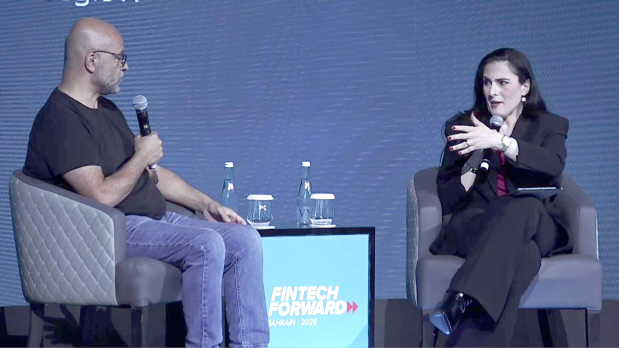
SOCIETY must prioritise human connection, ethics, and critical thinking as artificial intelligence rapidly integrates into daily life, former Google X chief business officer Mo Gawdat has emphasised.
At a fireside chat with Forbes Middle East senior presenter Sally Mousa during Fintech Forward 2026 at Exhibition World Bahrain, the best-selling author and technology veteran reflected on the evolution of AI, the economic realities of automation, and the global race for technological supremacy.
“Hugging my daughter – that’s always going to be mine,” Mr Gawdat remarked, highlighting that while routine cognitive tasks can be delegated to algorithms, core human experiences and emotional connections remain fundamentally irreplaceable.
Addressing the rapid pace of AI advancement over the past two decades, Mr Gawdat noted that early pioneers envisioned technology that would transform the world for the better. However, he cautioned that safety and alignment frameworks have failed to keep pace with the sheer speed of development.
Reflecting on recent conversations with his former colleague Geoffrey Hinton, who is frequently called the ‘Godfather of AI’, Mr Gawdat shared a sobering admission regarding their early expectations.
“I was naive,” Mr Gawdat recalled Mr Hinton telling him. “I thought that by the time we developed artificial superintelligence or general intelligence, we would have had enough time to talk about safety and security, and to have nailed that before we nailed the technology.”
Instead, commercial pressure and a competitive mindset pushed raw capability far ahead of guardrails. “The investment in advancements in tech development – in terms of how smart and how autonomous AI is – superseded safety alignment,” Mr Gawdat added.
Despite these warnings, Mr Gawdat expressed optimism about superintelligence itself, arguing that advanced intelligence naturally trends toward order, efficiency, and cooperation rather than destruction. The real danger, he noted, stems from human decision-making and ethical missteps rather than the machines themselves.
“When we fear superintelligence, we actually fear ourselves if we were that intelligent,” he explained. “The problem with us is if we assume that AI is going to behave like humanity if it’s in control.”
Responding to widespread concerns over job displacement, Mr Gawdat challenged the narrative that AI will completely replace human labour across all sectors, pointing to major economic hurdles.
In consumer-driven economies like the United States, roughly 70 per cent of gross domestic product relies on consumer spending. “If you replace all human labour, by definition, you’re replacing all human economic purchasing power,” he explained. “Accordingly, consumption disappears, and the GDP goes away.”
Furthermore, funding Universal Basic Income without income tax revenues from working citizens remains mathematically unviable. “If you give every adult in the US $16,000 a year, America needs to pay its citizens $5 trillion a year on a tax bill of less than $1 trillion that comes from things outside income tax,” he pointed out. “Take that out of the equation, there is no UBI.”
More importantly, total automation ignores the strength of collaborative systems, as hybrid teams combining human judgment with AI capabilities consistently outperform AI or humans working in isolation. “A hybrid team of a human and an AI performs way better than AI alone or humans alone,” Mr Gawdat asserted, citing corporate examples where total reliance on AI in customer-facing roles resulted in financial losses and increased customer churn.
Commenting on geopolitical competition between major powers, Mr Gawdat highlighted contrasting strategies between the United States and China. While US strategy leans heavily toward massive infrastructure spending and proprietary models, China has focussed on industrial AI, energy access, and cost-disruptive open-source models such as DeepSeek.
Mr Gawdat warned against any single nation or corporation achieving unchecked intelligence supremacy, advocating instead for open, accessible, and balanced technological progress worldwide.
“I surely prefer that nobody wins,” he said. “I think everyone needs to become aware that if someone has intelligence supremacy over the rest of us, this is unchecked power that’s irreversible.”
To navigate a world where intellectual tasks are increasingly automated, Mr Gawdat outlined six essential capabilities under his A-I-D-A-C-E framework.
First, agility requires adapting rapidly in both business and education to stay ahead of shifting landscapes.
Second, augmented intelligence focuses on utilising AI to expand human understanding and foster personal growth rather than outsourcing critical thought entirely. “Do not replace yourself with an AI,” he urged. “Use them to be smarter, not to replace yourself with them.”
Third, debate serves as a crucial tool against misinformation, with Mr Gawdat recommending pitting different AI models such as Gemini, DeepSeek, and Claude against one another to expose bias and identify objective truth. “That debate makes me smarter, but more interestingly, makes me find the truth,” he noted. “And the truth is the most valuable asset in our world today.”
Fourth, acquiring analogue skills ensures individuals retain practical, non-digital capabilities in the physical world, such as farming, mechanics, or carpentry.
Fifth, cultivating human connection remains essential, as authentic empathy, trust, and face-to-face presence represent premium assets that machines cannot replace. “In a world where all intelligence can be performed by machines, then you and I connecting as humans is the ultimate skill,” he said.
Finally, practicing ethics ensures that humanity models strong moral values and responsible behaviour today, teaching future AI systems to act with benevolence as they evolve.
avinash@gdnmedia.bh
&uuid=(email))