

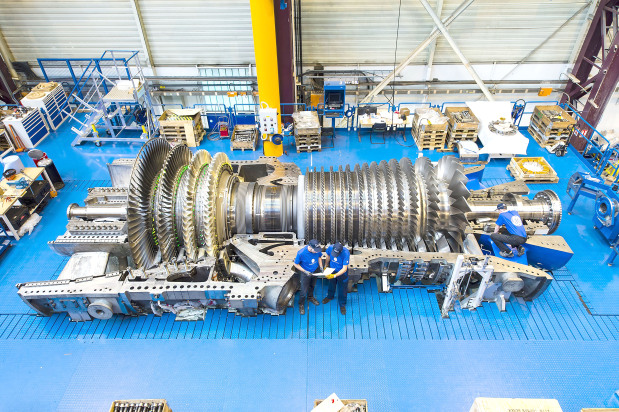
MANAMA: GE Power has announced that its HA gas turbine has become the fastest growing fleet of gas turbines in the world with 76 units ordered by 25+ customers across 15+ countries and the 26th unit entering commercial operation.
The new plant uses two 7HA.01 gas turbines and associated engineered equipment package.
The 805-megawatt (MW) combined-cycle plant can provide the equivalent power needed to supply more than 800,000 US homes, and the HA’s dual-fuel capability allows the turbines to run on a variety of fuels, adding significant reliability benefits to the region.
GE’s HA debuted in 2016 as the world’s largest, most-efficient and advanced heavy-duty gas turbine, and since then, it has delivered two world records for efficiency across 50- and 60-hertz segments.
The HA has achieved more than 118,000 operating hours and is the fastest growing fleet of gas turbines in the world with 76 units ordered by more than 25 customers across 15+ countries.
“With the broadest portfolio of fuel choices and industry-leading technology, GE Power is leading customers through this energy transition,” said GE Power president and chief executive Russell Stokes.
“We continue to see gas playing an important role in the world’s energy mix including as a complement to variable renewables.
Our HA technology enables unprecedented levels of efficiency to help customers reach more aggressive emissions goals.”
GE Power is also continuing its investments in its existing fleet.
GE Power and Vattenfall Wärme Berlin AG – a subsidiary of Swedish utility Vattenfall AB – announced the new MXL2 with Additive Manufactured Performance – the world’s first upgrade solution for GE’s GT13E2 gas turbines that uses key components manufactured using additive technology.
The new MXL2 can help gas plant power producers save up to $2 million in fuel annually, while opening up the potential for additional revenue of up to $3m annually in new power capacity.
According to the International Energy Agency, world energy demand is expected to rise 30 per cent through 2040, which is the equivalent of adding another India and China to today’s energy demand.
To meet this increase in demand, natural gas, rapid rise of renewables and energy efficiency improvements will lead the way.
&uuid=(email))