

MANAMA: Bond and sukuk issuances by GCC governments are expected to decline in 2021 relative to last year, according to Kamco Invest.
The Kuwait-based asset manager also sees total full year issuances falling short of last year’s levels, despite the growth in corporate offerings.
“We expect government issuances to slow down, led by higher oil prices that is easing pressure on the fiscal front, although we can still see opportunistic issuances from the government to take advantage of low rates,” says Junaid Ansari, head of investment strategy and research at Kamco Invest.
Corporates, on the other hand, are expected to see growth vs. last year but that may not fully offset the decline from government issuers during H2-2021.
It notes that GCC bond and sukuk issuances remained broadly stable year-on-year (YoY) at $80 billion during H1-2021.
Private businesses raised close to $50bn (up 59pc YoY) as against $30bn (down 40.5pc YoY) from the government in the first half this year.
Among the three biggest issuers in the GCC, UAE and Saudi Arabia continue to tap the fixed income market to fund budget deficits, while Qatar showed a steep decline in H1-2021 issuances, following two consecutive year of declines in full year issuances in 2019 and 2020.
“For the remainder of the year, we expect to see a further slowdown in issuances in the GCC, mainly from the government, as oil prices continue to remain elevated at almost 3-year high levels over the $75/b mark,” says Mr Ansari.
This would significantly reduce the government’s infrastructure funding shortfall, thereby providing a much needed breather to the increasing debt-to-GDP ratio for the bulk of the GCC.
According to the IMF, fiscal deficit for the GCC countries is expected to decline from 9.2pc of GDP to 3pc of GDP in 2021 and further down to 1.4pc in 2022.
These estimates were made at a time when oil prices were just over the $60/b mark, explains Kamco.
With prices now significantly higher and consensus expectations of $67/b in Q3-2021 followed by $70/b for Q4-2021, higher oil revenues are expected to further lower deficits.
On the other hand, the expected accelerated economic recovery during H2-2021 backed by vaccinations and lowered restrictions could result in higher business investments.
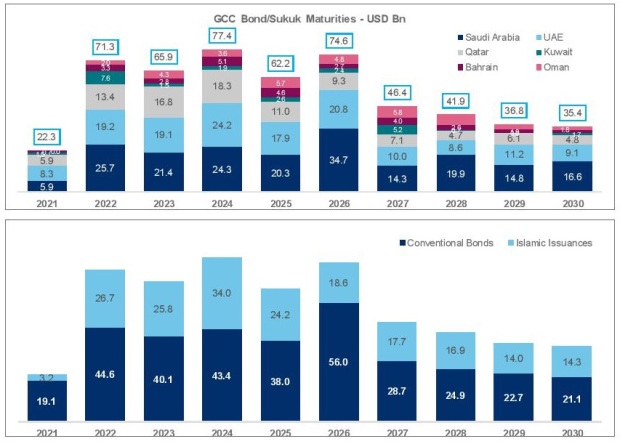
With an additional $22.3bn in refinancing requirements during the second half, total issuances are expected to exceed the $100bn mark for the year, says the firm.
In addition, there are significant deals in the pipeline that would add to total issuances but is expected to fall short of last year’s levels.
Funding requirements are apparent in the equity market with the announcement of a number of IPOs recently, while the historical low interest rates provides equal motivation to tap the fixed income market for investment needs.
avinash@gdn.com.bh
&uuid=(email))