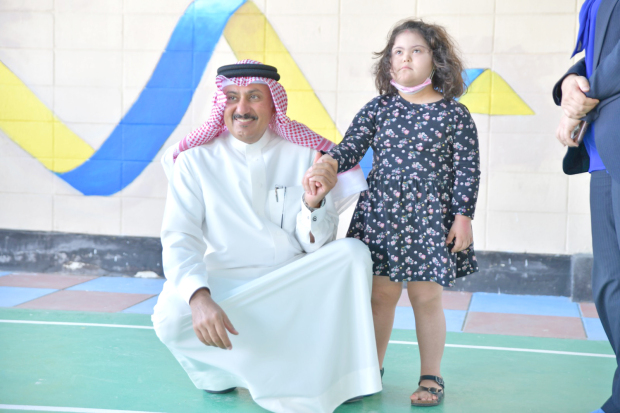
A CENTRE catering to special needs people has stepped up its efforts to make a “positive difference” in the lives of families as they battle the coronavirus (Covid-19) pandemic.
The Down Syndrome Care Centre, which handles almost 300 active cases, switched to online platforms to provide psychological and professional support as well as for recreational and social interactions.

The centre has six specialists for almost 300 people of different ages
The adaptation was the need of the hour, said centre director Ahmed Al Ali, adding that the people they were caring for were highly vulnerable in the exceptional circumstances.
The founding member said the centre in Adliya, operating under the Down Syndrome Society, had 600 people on its rolls since it was set up in 1998.
“Some people with Down syndrome find it very difficult to adapt, in general, and to the changes required by the spread of Covid-19, in particular,” Mr Al Ali told the GDN.
“Many struggle to cope with the current situation and new procedures. Skills and behaviour in some have declined, clearly affected by interruptions in completing their programmes and services.
“Depression and anxiety have also increased among some children and adolescents.
“They may also have difficulty adopting safety and health measures to reduce the risk of Covid-19, such as wearing masks, washing hands and physical distancing.
“Hence, we took the role of making a positive difference in the lives of parents and families as we deal with the epidemic and its consequences.
“We have regular access to assess needs and provide psychological and professional support through evaluations, training sessions and virtual lectures through the Zoom and WhatsApp.
“We also have recreational and social interactions, and events at the centre, taking all precautionary measures for the safety of students.”
Down syndrome is a condition in which a person has an extra chromosome – a small “package” of genes in the body which determine how a baby’s body forms and functions as it grows during pregnancy and after birth.
Typically, a baby is born with 46 chromosomes. Babies with Down syndrome have an extra copy of one of these chromosomes, chromosome 21. This extra copy changes how the baby’s body and brain develop, which can cause both mental and physical challenges for the baby.
Even though people with Down syndrome might act and look similar, each person has different abilities. People with Down syndrome usually have an IQ in the mildly-to-moderately low range and are slower to speak than other children.
Mr Al Ali noted that parents were also trained continuously online on how to establish a home training programme for Down syndrome children.
“We did 64 virtual classes in addition to 156 individual online sessions, with 180 students receiving early intervention, special education and speech services, as each student receives two services per week through direct follow-up with the specialist through the Zoom and WhatsApp,” he said.
“We can all help reduce the spread of Covid-19 by following the safety precautions as well as urging parents to inoculate their children with Down syndrome to help them and protect them from increased risks.”
He added that Eid Al Adha celebrations at the centre were limited to online greetings.

A staff member trains a child at the centre
The centre accepts people with Down syndrome from as young as month-old babies, and currently also has people aged 50 and above. It runs training programmes through a 30-member staff including six specialists and 10 assistants.
“We have a separate department to help trained people find jobs, which is one of our main projects,” said the 58-year-old father whose 31-year-old daughter with Down syndrome is working at the National Bank of Bahrain.
“We help those aged 17 or 18 and above find employment; since 2018 we have placed 19 people in jobs.
“Another 30 people are getting trained under this start-up project of the Down Syndrome Society.”
People are placed in jobs after 6–12 months of training at the centre which includes a mock site; at the job they are accompanied by shadow staff.
Mr Al Ali noted that 40 per cent of the funding for the centre, which offers free services, comes from public donations and rest from the government.
Bahrain currently has around 800 people with Down syndrome.
“Around 16 to 20 babies are born with Down syndrome annually in Bahrain.
“The best way to help and support them is to integrate them into society; as long as they are isolated, they will need care and will never be independent.”
raji@gdn.com.bh