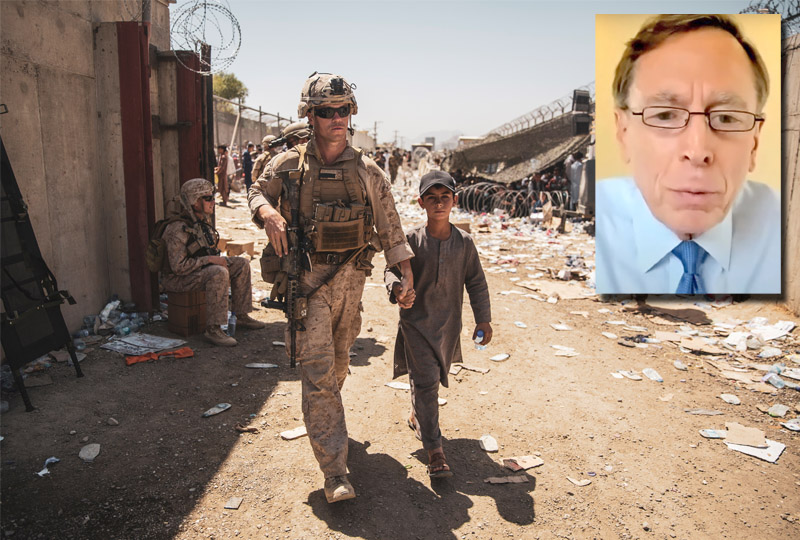
THE US has “damaged its alliances” globally by retreating from a war which it “could not win” in Afghanistan, said a retired four-star US army general.
David Petraeus, a former top commander in the Middle East and a former Central Intelligence Agency (CIA) director, also highlighted the US failure, bleak financial future of Afghanistan under the Taliban and warned of the rise of virtual caliphates.
He was speaking during a webinar on ‘The State of Play in Afghanistan’ hosted by the American think tank, Atlantic Council.
“As the enormity of the events in Afghanistan this past week sinks in, the questions start,” said Mr Petraeus, who served in Afghanistan from 2010 to 2011.
“How did this happen? How could we not have foreseen it? Why didn’t Afghan security forces put up a fight? Why didn’t we do something about corruption?
“The list goes on.”
During the virtual event, Mr Petraeus said during his time in Afghanistan there were about 85,000 US troops and Taliban did not control the 34 provincial capitals.
“When President (Barack) Obama left office, there were fewer than 10,000 troops.
“And when Mr (Donald) Trump departed, there were fewer than 5,000.
“The Taliban still did not hold any major urban area. Now they hold the entire country. What changed so swiftly and completely? We did.”
“Mr (Joe) Biden’s decision to withdraw all US forces destroyed an affordable status quo that could have lasted indefinitely at a minimum cost in blood and treasure.”
He added that the US lacks “strategic patience” which ironically President Biden’s administration is demonstrating in Iraq, Syria, Somalia, and elsewhere in Africa.
“Our lack of strategic patience at critical moments, including from President Biden, has damaged our alliances, emboldened our adversaries and increased the risk to our own security.
“It has flouted 20 years of work and sacrifice.
“We needed to acknowledge that we could not win the war in Afghanistan, given that the enemy had sanctuaries and a variety of other factors that made it an exceedingly difficult place to truly prevail.”
Mr Petraeus stressed the US “hasty withdrawal” has opened doors for Al Qaeda that has a “magnetic attraction” for eastern Afghanistan.
He also warned of Al Qaeda and Islamic State threats looking to establish sanctuaries and use social media to recruit and radicalise youth.
Both terror outfits have the capabilities to establish ‘virtual caliphates’ in cyberspace to recruit, motivate, share explosive formulae, tactics, techniques, and fuel up attacks outside Afghanistan.
“If (the Taliban) really want to prove that they truly mean what they say about ensuring that Al Qaeda and the Islamic State are not welcome on their soil, they should welcome us back to Bagram Air Base.”
He did not rule out the US re-occupying its sprawling $750 million embassy in Kabul to maintain American presence in Afghanistan.
According to the veteran army general, trained Afghans did not fight back the Taliban due to corruption, among other issues.
“But they would fight if they knew that somebody had their back, and for quite a while we had their back,” he said.
He said the sanctions imposed on Taliban could eventually affect services in Kabul. The Taliban cannot access almost all of the Afghanistan central bank’s $9 billion in reserves, most of which is held by the New York Federal Reserve.
Afghanistan was also slated to access about $450m from the International Monetary Fund but this has been blocked pending recognition of a new Afghan government.
“So, the lights literally could go out in Kabul,” said Mr Petraeus.
“If you can’t get refined fuel products in and other means of keeping generators going ... and that’s just the tip of the iceberg.
“Their assets around the world, in most places, have been frozen.
“They’re going to be in a very, very tough situation.”
Speaking on the chaos surrounding evacuations from Kabul, Mr Petraeus said Washington and the State Department must decide who gets in a plane and flies out of Afghanistan, and to where.
“It appears to me that there is no true system for those inside Afghanistan beyond American citizens, green cards, and Special Immigrant Visas for Afghans.”
“We have written right now a very substantial blank cheque that I fear we may struggle to redeem.”
Tens of thousands of people remain to be evacuated ahead of the August 31 US deadline to withdraw its troops from the country.