

FOR the second year in a row, a senior Saudi royal slammed Israel for its hypocritical stance on regional stability and nuclear non-proliferation.
Saudi Prince Turki Al Faisal Al Saud, former ambassador to the US and the UK, called on the Jewish state to join the Arab Peace Initiative if it was serious about stability in the region.
The initiative is a 10-point proposal, endorsed by the Arab League, which offers Israel a normalisation of relations with the Arab nations in return for a full withdrawal from territories including West Bank, Gaza, Golan Heights and Lebanon, a settlement of Palestinian refugees, and the establishment of a Palestinian state with East Jerusalem as its capital.
Prince Turki sharply criticised Israel for ‘colonising territories’ and building an ‘apartheid wall’ even as it continued to deny Palestinians their rights.
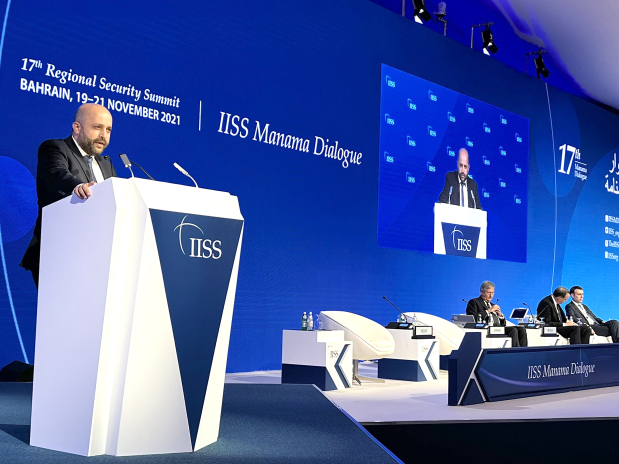
The showdown took place during a question-and-answer segment of the final plenary session, titled ‘Militias, Missiles and Nuclear Proliferation’, of the 17th edition of the IISS Manama Dialogue at the Four Seasons Hotel Bahrain Bay.
Prince Turki, who was representing the King Faisal Centre for Research and Islamic Studies, also questioned if the present Israeli government was committed to a two-state solution and asserted that Israel should also look at dismantling its own nuclear capability alongside attempts to dismantle Iran’s nuclear programme.
In response, Israeli National Security Adviser Dr Eyal Hulata said that “Israel’s role in the region has been stabilising, rather than destabilising”.
He also asserted that stability in the region can be achieved in parallel with a solution to the Palestine-Israel conflict, instead of the former depending on the latter.
“Israel is committed to stability and improving the lives of the Palestinians,” he added, noting that his country only wishes for Hamas to stop ‘accumulating arms and firing on citizens and towns’.
Earlier, addressing the session, Dr Hulata said Iran was the most destabilising force in the region and declared Israel’s intention to never allow the Islamic republic to become a nuclear-weapon state.
“From the Arabian Gulf to the Red Sea, from the Arabian Sea to the Mediterranean, Iran and its proxies continuously threaten civilian life and feed on chaos in failed states,” he noted.
“Iran deployed proxies on our borders and sponsored militias around the Gulf and elsewhere as agents.”
Dr Hulata, who has served for 23 years in the Mossad – Israel’s national intelligence agency – held Iran responsible for the 2019 drone strike on Saudi Aramco’s Abqaiq and Khurais facilities, the MT Mercer Street attack near Oman in July this year, and the recent attempted assassination of Iraqi Prime Minister Mustafa Al Kadhimi.
He cited these events as evidence that Iran has been building up its military, missile and drone capabilities in recent years.
He said nuclear proliferation was the greatest strategic threat to the region.
“Think about how much bolder and more dangerous Iran will be with a nuclear weapon, should it achieve its nuclear ambitions,” he said.
“The free world will face extreme threats it hasn’t faced before. With Iran’s new nuclear refineries and the collapse of the existing non-proliferation regime, this is our time to deliver a strong and unified message – we will never allow Iran to go nuclear.”
Dr Hulata also emphasised the Abraham Accords, signed last year, and earlier peace treaties with Jordan and Egypt as blueprints for stable relations within the region.
He restated the need to continue working on sustainable joint defence architecture and pointed out that bilateral relations can offer opportunities beyond defence.
As an example, he cited an agreement to be signed today between Israel and Jordan which will see Jordan constructing a large solar farm to provide its neighbour with electricity, in exchange for Israel building a desalination plant to supply fresh water to the kingdom.
&uuid=(email))