

A HIGH concentration of the coronavirus has been found in wastewater following a study, according to an official.
More than 80 per cent of the samples collected from the Muharraq Sewage Treatment Plant (STP) and various Covid-19 quarantine facilities showed the presence of SARS-CoV-2.
National Taskforce to Combat the Coronavirus (Covid-19) monitoring committee head Dr Manaf Al Qahtani, who was part of the study, said testing wastewater could also track the prevalence of the all types of viruses in the community. “The study revealed SARS-CoV-2 detection in wastewater from Muharraq correlates with reported Covid-19 cases in Bahrain,” he said on Twitter.
“Wastewater collected from Covid-19 quarantine facilities showed a high concentration of the virus.
“These findings suggest that wastewater analysis can forecast or confirm SARS-CoV-2 circulation in a specific population.
“Furthermore, reverse transcription-polymerase chain reaction (RT-PCR) testing is a reliable method for identifying and quantifying coronavirus in wastewater samples.
“This could be a complementary approach to tracking the virus’ prevalence in communities, and monitoring should include detection of other viruses,” added the BDF Hospital microbiologist.
In the global fight against Covid-19, wastewater-based epidemiology (WBE) is a proven environmental surveillance tool.
Global studies have confirmed that coronavirus testing in wastewater can assist policymakers in surveying a specific infectious community.
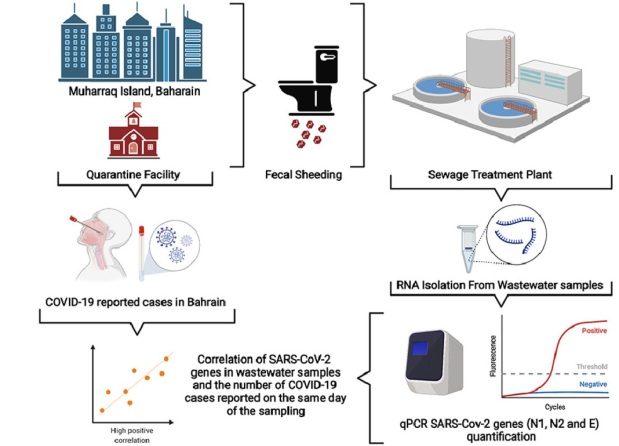
A graphical representation of a Bahrain study on wastewater for Covid-19
The study, “Long Term Detection and Quantification of SARS-CoV-2 RNA in Wastewater in Bahrain”, published on the research website Science Direct, was based on tested samples collected from the Muharraq STP between February 2020 and October 2021.
The discrete sewerage catchment has a capacity of 100,000m3/day and serves approximately 260,000 people. It primarily serves domestic customers, but it also serves several hospitals and Bahrain International Airport.
“SARS-CoV-2 viral genes were detected in wastewater samples by RT-PCR shortly after the first cases of Covid-19 reported by health authorities in Bahrain,” said the study.
“The viral genes were detected in 55 of 65 samples (84.62 per cent) throughout the study period.
“Furthermore, wastewater samples from two Covid-19 quarantine facilities were analysed, and higher SARS-CoV-2 gene concentrations were found.
“Our findings highlight the potential use of RT-PCR for SARS-CoV-2 detection and quantification in wastewater, as well as the moderate correlation between virus gene concentrations and reported Covid-19 cases for a specific population.
“Indeed, this research identifies this technique as a mechanism for long-term monitoring of Covid-19 infection levels, giving public health and policymakers a useful environmental surveillance tool during and after the current pandemic.”
The region’s first long-term wastewater monitoring study also reveals that, despite the success of vaccination programmes in containing the virus’s spread, the presence of the virus in wastewater is indicative of its presence among the population.
The authors stressed that the study was limited to Muharraq STP samples and not the entire country because data on the incidence of Covid-19 cases in Bahrain for individual areas is not available.
During the study period, daily Covid-19 cases ranged from 0 to 3,275, with four epidemic peaks recorded: June-July 2020, September 2020, February-April 2021, and May-June 2021, with the largest peak occurring in May 2021.
“The findings show a strong match between the quantification of the virus in Muharraq wastewater and the major Covid-19 incidence peaks in Bahrain,” the study concluded.
“By reporting gene detection in wastewater, this study provides relevant information that can be used in further monitoring sewage-based surveillance programmes in Bahrain, where perhaps other CoVs, such as MERS-CoV, should be included in the monitoring given the Middle East’s high incidence.”
N J Stevenson and E Rajab from the Royal College of Surgeons in Ireland (RCSI) Bahrain, J Herrera-Uribe from Trinity College Dublin, P Naylor and B Mathews from Muharraq STP, and Gulnur Coskuner and Majeed Jassim from the University of Bahrain’s Chemical Engineering Department were the other researchers.
Bahrain recorded its first Covid-19 case in February 2020, and there have been 577,652 cases since then (as of May 15), including 570,461 recoveries, 5,712 active cases, and 1,479 deaths.
raji@gdn.com.bh
&uuid=(email))