

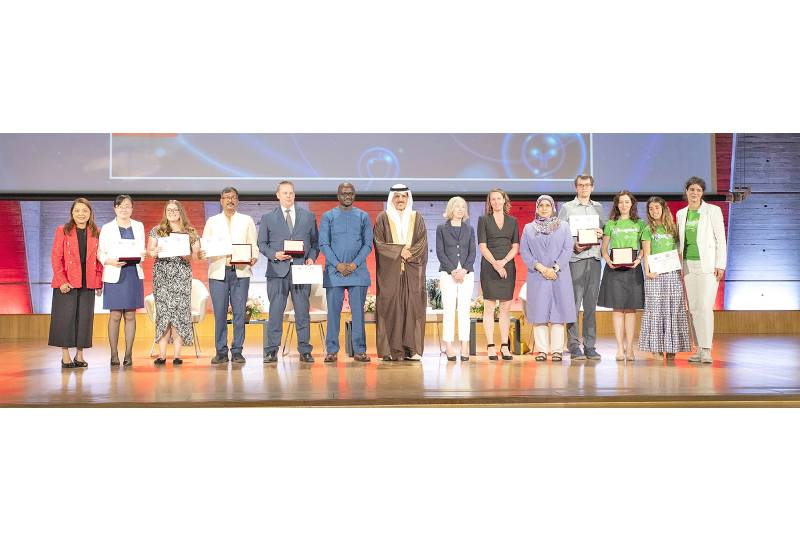
Winners of the prestigious Unesco King Hamad Bin Isa Al Khalifa Prize for the Use of ICT in Education were honoured at a ceremony at the Unesco headquarters yesterday.
The event was held under the patronage of His Majesty King Hamad in co-operation with the Education Ministry. The King deputised Education Minister Dr Majid Al Nuaimi to attend the ceremony and present the awards to the 11th and 12th editions’ laureates, who have not been honoured due to Covid restrictions, in addition to the winners of the current edition.
The ceremony was attended by Unesco assistant director general for education Stefania Giannini, General Conference president Ambassador Santiago Irazabal Mourão, senior Unesco officials, ambassadors, media professionals, researchers and specialists in the fields of information and communication technology, in addition to Bahraini students studying at French universities.
Congratulations
Dr Al Nuaimi, in his speech, conveyed greetings and congratulations from His Majesty and His Royal Highness Prince Salman bin Hamad Al Khalifa, Crown Prince and Prime Minister, to the jury and officials of the prize, as well as the winners.
He affirmed the kingdom’s support for Unesco’s programmes and studies, and commended the efforts of the Unesco director general in leading the international organisation under various circumstances, citing its positive role in backing efforts to ensure continuity of education during the spread of the pandemic.
He pointed out that the award has become one of the leaders in honouring pioneering initiatives in the field of the use of ICT in education.
Dr Al Nuaimi highlighted the kingdom’s efforts to ensure the continuity of education during the pandemic, citing its success in providing education through the educational portal (eduNet), televised lessons and 14 YouTube channels, including one channel for students with special needs and another in technical and vocational education.
Ms Giannini said the prestigious prize has become an educational reference that keeps pace with modern developments, as it has achieved great success and become very popular all over the world.
- The awards of the 2019 edition, themed “The use of artificial intelligence to innovate education, teaching and learning”, were presented to Brazil’s Letrus and Spain’s Change Dyslexia.
The “Letrus Literacy Programme” is an education technology start-up that has developed a programme for automated feedback on students’ writing. It aims to reduce functional illiteracy in the Portuguese language by improving practice opportunities for secondary school students and teachers.
Change Dyslexia is a social company that has developed a screening tool to detect dyslexia in Spanish speakers all over the world in 15 minutes. It also provides game-based exercises for learners with dyslexia to overcome writing and reading difficulties.
- The awards of the 2020 edition, themed “The use of artificial intelligence to enhance the continuity and quality of learning”, were presented to One College Student Per Village of Open University of China and Centre for Learning Analytics of University of Turku, Finland.
The One College Student Per Village programme uses AI to provide learners from rural and remote areas with quality learning opportunities.
The collaborative education platform “ViLLE” developed by the Centre for Learning Analytics offers a personalised set of exercises based on students’ performance and provides teachers with detailed reports on their students’ progress.
- The awards of the 2021 edition, themed “The use of technology to enable inclusive crisis-resilient learning systems”, were presented to Initiatives for Inclusive and Accessible Education during Covid-19 implemented by the Central Institute of Educational Technology, National Council for Educational Research and Training from India; and “Digital Educational Programme” implemented by Ubongo from Tanzania.
&uuid=(email))