

Women need to be encouraged to apply – and be offered – more health leadership opportunities, according to a local study that revealed fewer than half hold senior positions in the sector compared to men.
The ‘stark’ gender imbalance has been highlighted in a trend analysis published this week by the UK-based for-profit scientific open access publisher BioMed Central’s Journal that observed that almost 60 per cent of leadership roles in the field were male dominated.
Of the 653 leadership positions in Bahrain that were on the study, 388 (59.4pc) were held by men and 265 (40.6pc) were held by women.
This comes despite figures revealing that female medical students’ representation was slightly higher than males over almost the past two decades.
However, the first-of-its-kind study titled ‘Women’s contribution to medicine in Bahrain: leadership and workforce’ noted that Bahrainis dominated the majority of the senior positions compared to expatriates.
The research scholars from the Health Ministry, BDF Hospital, King Hamad University Hospital (KHUH), the Arabian Gulf University (AGU) and Fairmont State University, West Virginia who compiled the study recommended training programmes to overcome the gender imbalance.
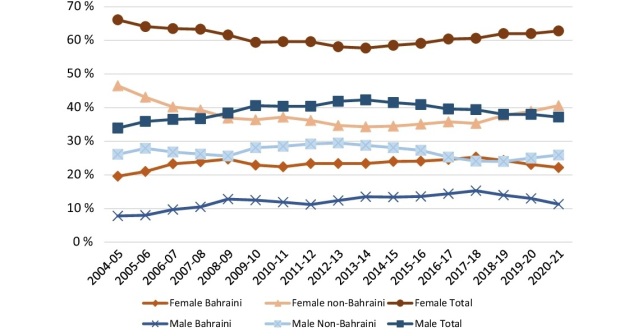
Percentage of medical students graduates in Bahrain by gender and citizenship
According to the authors, including Bahrain Medical Society president and BDF Hospital emergency department specialist Dr Ghada Al Qassim, the study aimed to recognise the contribution made by women in the Bahraini healthcare sector by determining the gender distribution at medical schools, government hospitals, Health Ministry, and National Health Regulatory Authority (NHRA).
“The increase in the number of women in the medical community has been evident globally and the same trend is clearly reflected in Bahrain,” concluded the study. “Although the number of males in leadership positions is slightly higher than that of females currently, with the continued growth in the number of female medical students and physicians, it is likely that these positions will be dominated by females in the future.
“What requires particular focus is the stark imbalance between male and female physicians in certain specialties. Females should be encouraged to enter training programmes, where there is a severe shortage of females, and not be deterred from specialising in male-dominated specialties.
“The results shown in this study could be used to direct decision-makers to strive to balance the number of male and female physicians in some leadership posts and in residency training programmes.”
The study added: “Trend analysis indicated that there were more female medical students than males over the years.”
Physicians with a bachelor’s degree in Medicine and Surgery and a valid licence to practise from NHRA were eligible to participate in the study. Data was collected from the Health Ministry, NHRA, Salmaniya Medical Complex, KHUH, BDF Hospital, AGU and the Royal College of Surgeons in Ireland-Bahrain, as well as two medical schools in Bahrain to see the trend in female enrolment into medical schools since 2004.
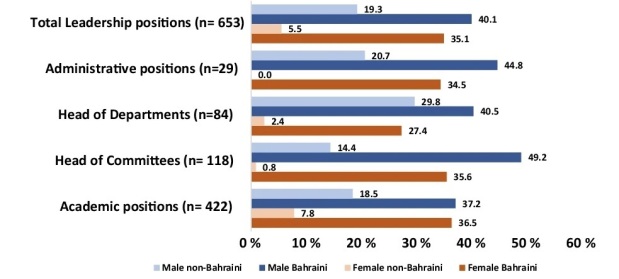
Leadership positions by gender and citizenship
On physician workforce, NHRA reported 3,734 licensed physicians in Bahrain, which included 1,108 (29.6pc) consultants, 674 (18.05pc) specialists and 1,952 (52.2pc) physicians with general licences. The total number of male physicians constituted 1,782 (47.8pc), while females were 1,952 (52.2pc) of the workforce in Bahrain.
There was a higher number of women with general licences compared to men (62.3pc vs 37.7pc), especially when compared to the gender distribution of consultants (43.3pc vs 56.7pc) and specialists (37.8pc vs 62.2pc), both of which were dominated by men.
Although most consultants and specialists were men, specialties such as family medicine (75.7pc vs 24.3pc) and Obstetrics and Gynaecology (87.9pc vs 12.1pc) were dominated by women.
Within medical and surgical specialties (represented by consultants and specialists only), men dominated all medical (except for clinical geneticist, 100pc female) and surgical specialties.
Among medical students trend indicated more female students over the years had been attracted to the profession with an average increase of 7.2pc from 2004 to 2021 per year.
The average annual increase of female Bahraini medical students from 2004 to 2021 was 8.4pc, and 6.4pc for female non-Bahraini students. Trend analysis indicated that there were more female non-Bahraini students than female Bahraini students over the years; the difference being significantly higher in academic years 2020-21 compared to initial year.
Among Bahraini students, trend analysis showed that the number of females were comparatively higher than males, but there was no significant difference.
Data was limited to sector and did not include physicians who may have been in the process of renewing their licence or those who had failed to renew their licence.
raji@gdnmedia.bh
&uuid=(email))