

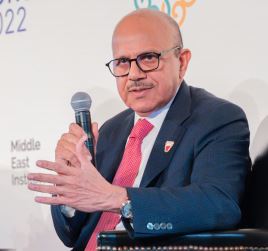
THE Foreign Minister has highlighted how Bahrain has been able to turn challenges into opportunities and success stories, thanks to its team work.
“Team Bahrain has presented a pioneering model in overcoming the repercussions of the Covid-19 pandemic, as the kingdom provided free health services and examinations for all citizens and residents without discrimination, granted nearly 3.5 million doses of vaccines, representing more than 230 per cent of the total population, 67pc of whom have received the booster dose,” Foreign Minister Dr Abdullatif Al Zayani said while delivering a speech at the 77th Session of the United Nations General Assembly yesterday.
“This is in addition to the launch of a financial and economic package since March 2020 worth $12 billion, equivalent to a third of gross domestic product, to support the most affected individuals and sectors, and to reduce the economic and social repercussions, leading to the kingdom deservedly being placed first in the world in the recovery rate according to international indicators.”
The minister also outlined Bahrain’s integrated plan for economic recovery that includes the completion of an advanced national programme for employment and training of citizens, launching major strategic development projects, establishing new investment and industrial zones, developing oil and non-oil economic sectors along with the shift to the fourth industrial revolution, with support for the digital economy and artificial intelligence technologies.
“Out of its awareness of the interdependence between the environment, natural resources and human, food and water security, Bahrain has affirmed its support for the four major international initiatives in the field of climate change, and its commitment to achieving net zero by 2060, reducing emissions by 30pc by 2035, doubling green spaces, and enhancing the effective use of energy and renewable energy sources,” he said.
Mr Al Zayani also highlighted the Alternative Sanctions and Measures Law, which has benefited more than 4,200 convicts since its implementation in May 2018, as well as its open prisons systems, adoption of the law on restorative justice for children and the protection of children from ill-treatment, in addition to other legislation that supports human rights in a society based on freedom, equality, justice, security, and social solidarity.
“In order to enhance human rights and developmental gains, the government has this year approved the National Human Rights Plan (2022-2026), which includes 102 projects, prepared in co-operation with the Office of the United Nations Resident Coordinator,” he added.
&uuid=(email))