

Bahrain has been ranked one of the safest places in the world, with the country’s disaster preparedness earning it a spot amongst the top 10, according to the World Risk Report.
The report has been published by Bündnis Entwicklung Hilft (BEH), a German alliance of not-for-profit organisations, and the Institute for International Law of Peace and Armed Conflict at Ruhr University Bochum (IFHV).
Bahrain was ranked 184th amongst the world’s 193 countries for risks in the World Risk Index (WRI) where the lower ranked a country, the less risky it is to live there, and the better their disaster management. At an impressive tenth least-risky place to live, the kingdom ranks higher than Qatar (20th), UAE (119th) and Saudi Arabia (137th).
“Like every year, the WorldRiskIndex 2022 is complemented by a focus topic and this year we are looking at digitalisation,” BEH chairman Wolf-Christian Ramm and IFHV executive director Dr Pierre Thielbörger said, in a statement.
“Based on qualitative research, the authors analyse the great importance of digital solutions for disaster risk reduction and anticipatory humanitarian action, for example in the context of early warning, the processing of complex data sets for needs assessment, and the transmission of cash transfers.”
Cover of the report
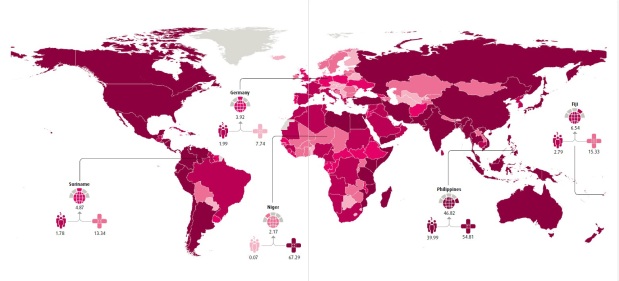
Overall, the report found that the countries with the highest disaster risk are the Philippines, India and Indonesia.
In terms of continents, the Americas is at the highest risk of devastating disasters, followed by Asia and Africa.
The index explores the relationship between each country’s natural exposure to risk and its vulnerability as a result of the country’s means to manage this risk, to come up with the overall WRI for each country.
To come up with the exposure component of the index, the report assesses the occurrence of natural disasters like cyclones, coastal flooding, drought, earthquakes and tsunamis.
For the vulnerability aspect, socio-economic factors and vulnerability to disease and conflict are assessed to determine susceptibility. This is then stacked with health care capabilities and government stability to determine coping capability and finally, education, research and investment capacities help determine the adaptive capacity of the country. The exposure and vulnerability indices are then added and the square root of the sum is used to generate the WRI.
Bahrain received an overall WRI ranking of 0.95, consisted of a 0.14 exposure to natural disaster risk, balanced against a 6.5 vulnerability rating … placing it an admirable 10th in the world.
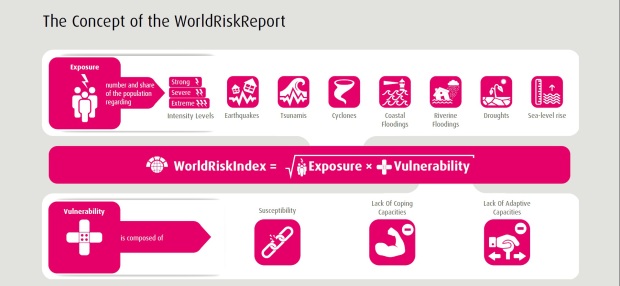
The formula and factors used to determine each country’s WRI
Susceptibility was given a rating of 5.14, coping capacities received a rating of 2.68 and adaptive capacity was assessed at 19.91. Lower index scores indicate a better disaster readiness.
For comparison, the Philippines, the world’s riskiest place to live, received an overall WRI of 46.82, comprising a 39.99 exposure to natural disaster risk, balanced against a 54.81 vulnerability rating. Susceptibility was given a rating of 51.35, coping capacities received a rating of 57.81 and adaptive capacity was assessed at 55.48.
Overall, the report recommended that digital technologies and competencies must be made equally accessible to all people, digital structures must be in place and secure, data and digital techniques must be accessible and transparent, and data must be protected.
naman@gdnmedia.bh
&uuid=(email))