

BAHRAIN’S space programme is set to make its mark, securing the final frontier of outer space with its upcoming payload onboard a Mohammed Bin Rashid Space Centre (MBRSC) satellite, anticipated to be launched in 2024.
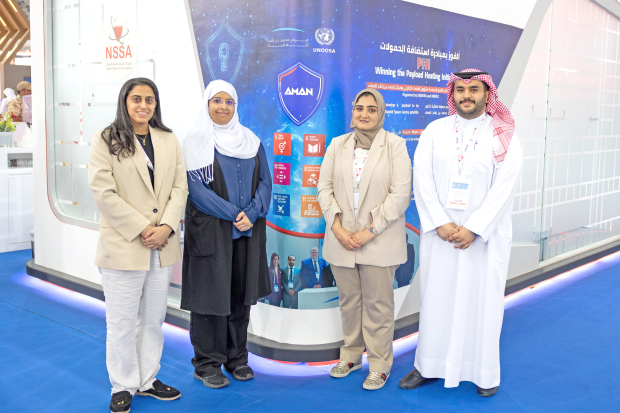
A team of four scientists from Bahrain’s National Space Science Agency was identified as the best amongst 533 global entities to create a cybersecurity-focused solution during the Payload Hosting Initiative, organised by the MBRSC and United Nations Office for Outer Space Affairs (UNOOSA).
The team is comprised of Aysha Alharam, Reem Senan, Yaqoob AlQassab and Muneera Al Malki, and their contribution to the satellite is being called the ‘Aman’ payload, which translates to security in Arabic.
“Cybersecurity in space is now a very important topic, and our proposal was identified as the top one, after a technical evaluation of the code,” team leader Ms Alharam told the GDN.
“Our Field Programmable Gate Array (PFGA) stood out – not only because it was able to effectively encrypt and decrypt photographs and data that the satellite will capture, but also as it is reprogrammable.
“This is important because it allows us to further optimise the code after it is launched to ensure that it is using power as efficiently as possible.”
The Aman payload and the satellite it will be part of, address six of the United Nations Sustainable Development Goals (SDGs) – gender equality; quality education; reduced inequalities; industry, innovation and infrastructure; peace, justice and strong institutions; as well as sustainable cities and communities.
The team identified cybersecurity as a potential issue to address because of the increasing risk that hackers could intercept images from satellites, manipulate the data and potentially even taking over the satellite, rendering it inoperable and increasing the space debris in outer space.
For Ms Alharam, who completed two Masters degrees in Computer Science and Engineering, one with a focus on cybersecurity, the project was a way to channel her knowledge into the emerging domain of space.
The entire team also brought the NSSA’s experience working with the UAE Space Agency to launch Light-1, a joint CubeSat 3U satellite, in December last year. The MBRSC satellite will be a 12U satellite, four times the size of the 3U, and will carry on board a number of experiments and sensors to collect data during its mission.
naman@gdnmedia.bh
&uuid=(email))