

Bahrain: A slight rise in maternal mortality rate was recorded in Bahrain last year, according to a study.
The New Global Burden of Disease study for 2015 (GBD 2015) by Washington University’s Institute for Health Metrics and Evaluation (IHME) registered 24.6 deaths per 10,000 deliveries last year, compared with 22 in 2013.
However, IHME Middle Eastern initiatives director Dr Ali Mokdad said Bahrain has made tremendous progress in this sector over the years.
“Since 1990, Bahrain has made tremendous progress in ensuring the health of mothers and improving child survival,” he told the GDN.
“Bahrain dropped its maternal mortality ratio from 53.6 deaths per 100,000 live births in 1990 to 24.6 deaths per 100,000 live births in 2015.
“In addition, fewer children under five years of age died in 2015 than in previous years, with the mortality rate of this age range dropping at an average of nearly five per cent per year between 1990 and 2015.
“The rate of under-five deaths in 2015 was 6.6 per 10,000 live births in 2015.
“When looking at maternal mortality specifically, Bahrain shows a lower maternal mortality ratio than Qatar, Egypt, Algeria, and Iraq.
“However, countries like Kuwait, Lebanon, and the UAE all fare better in this regard.”
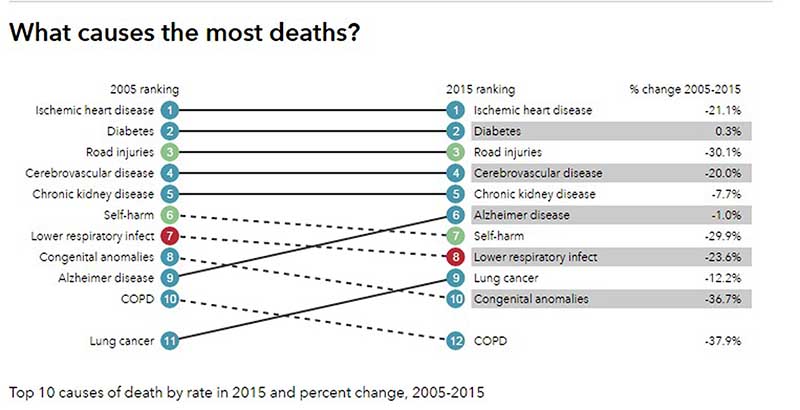
According to GBD 2015, the top five causes of death in Bahrain last year were ischemic heart disease, which caused 19pc of total deaths.
This is followed by diabetes (12.6pc), road injuries (5.2pc), cerebrovascular disease (4.8pc) and chronic kidney disease (4.1pc).
Meanwhile, the top five causes of years lived with disability (YLDs) in Bahrain for 2015 were low back and neck pain, which caused 12.4pc of the total, followed by diabetes (8.7pc), depressive disorders (8pc), sense organ diseases and other musculoskeletal disorders (5.4pc each).
The report states that in 2015, life expectancy in Bahrain was 78.2 years for males and 80.3 years for females, almost eight years above the global average.
The study examines Bahrain, Afghanistan, Egypt, Djibouti, Iraq, Iran, Jordan, Saudi Arabia, Kuwait, Lebanon, Libya, Morocco, Oman, Pakistan, Palestine, Qatar, Yemen, Somalia, Sudan, Syria, Tunisia and the UAE.
With more than 1,800 collaborators in 195 countries, the Global Burden of Disease is one of the largest and most comprehensive efforts measuring epidemiological levels and trends worldwide.
&uuid=(email))